
MARPOL Annex VI Explained: The 0.50% Sulphur Cap and Every ECA on One Globe
Last Updated: October 2026 · By V.K. Singh, Fleet Frontier

Every ship burning fuel oil today works between two numbers: 0.50% and 0.10%. Under MARPOL Annex VI Regulation 14, fuel sulphur is capped at 0.50% m/m worldwide since 1 January 2020, and at 0.10% inside Emission Control Areas (ECAs).
In October 2026, the 0.10% limit already applies in five ECAs. Two more, the Norwegian Sea and Canadian Arctic, are in force and their sulphur limit bites from 1 March 2027. A North-East Atlantic ECA follows in 2028.
This guide puts every zone on one globe, explains the dates, and shows what the rules mean for Indian cadets and engineers on board.
Quick Answer: MARPOL Annex VI limits the sulphur in ship fuel to 0.50% by mass anywhere in the world (since 1 January 2020) and to 0.10% inside Emission Control Areas. Active sulphur ECAs are the Baltic Sea, North Sea, North American, US Caribbean and Mediterranean. The Norwegian Sea and Canadian Arctic follow from March 2027, and the North-East Atlantic from September 2028.
What Is MARPOL Annex VI?
MARPOL is the IMO convention on preventing pollution from ships. Annex VI covers air pollution: sulphur oxides (SOx), nitrogen oxides (NOx), particulate matter (PM), ozone-depleting substances and energy efficiency.
Regulation 14 is the sulphur rule. It does not measure what comes out of the funnel. Instead, it limits the sulphur content of fuel oil as loaded, bunkered and used on board, as IMO explains on its Regulation 14 page.
Less sulphur in the tank means less SOx and fine particles in the air near coasts and ports, where people live.
The 0.50% Global Sulphur Cap (IMO 2020)
The global limit has come down in steps. The ECA limit tightened separately and earlier.
| Date | Global limit (outside ECA) | ECA limit |
|---|---|---|
| Before 1 July 2010 | 4.50% | 1.50% |
| 1 July 2010 | 4.50% | 1.00% |
| 1 January 2012 | 3.50% | 1.00% |
| 1 January 2015 | 3.50% | 0.10% |
| 1 January 2020 | 0.50% | 0.10% |
 The 2020 step, called IMO 2020, was the big one. It moved most of the world fleet off high-sulphur heavy fuel oil (HSFO, typically up to 3.50%) and onto very-low-sulphur fuel oil (VLSFO) or onto scrubbers.
The carriage ban from 1 March 2020
A second rule closed the loophole. From 1 March 2020, a ship may not even carry fuel above 0.50% sulphur for its own use, unless it has an approved equivalent such as an exhaust gas cleaning system (scrubber). Fuel carried as cargo is exempt. DG Shipping’s Engineering Circular 02 of 2019 restates this for Indian ships and bunker suppliers.
What Is an Emission Control Area (ECA)?
An ECA is a sea area designated by IMO where stricter air-emission limits apply. An ECA can control SOx and PM, NOx, or all three.
For this article, the key point is simple: inside a SOx ECA, fuel in use must not exceed 0.10% sulphur, unless the ship uses an approved equivalent such as a scrubber.
A new ECA does not bite on day one. Regulation 14.7 gives a 12-month exemption after the amendment enters into force, so fuel supply can adjust. That is why entry-into-force dates and “0.10% applies” dates differ in the table below.
Every ECA in the World: Complete List (2026)
| ECA | Where it covers | 0.10% S applies from | Status (Oct 2026) |
|---|---|---|---|
| Baltic Sea | Whole Baltic incl. Gulfs of Bothnia and Finland | 1 Jan 2015 | Active |
| North Sea | North Sea, Skagerrak, English Channel | 1 Jan 2015 | Active |
| North American | About 200 nm off US and Canadian coasts, incl. Hawaii | 1 Jan 2015 | Active |
| US Caribbean | Waters around Puerto Rico and US Virgin Islands | 1 Jan 2015 | Active |
| Mediterranean Sea | Entire Mediterranean | 1 May 2025 | Active |
| Norwegian Sea | Norwegian waters north of the North Sea ECA | 1 Mar 2027 | In force, grace period |
| Canadian Arctic | Canadian Arctic waters | 1 Mar 2027 | In force, grace period |
| North-East Atlantic | EEZs of Greenland, Iceland, Faroes, Ireland and mainland UK, France, Spain, Portugal | 1 Sep 2028 | Adopted, not yet in force |

A few details worth remembering:
- The North American ECA took effect on 1 August 2012 at 1.00%, and the US Caribbean ECA on 1 January 2014. Both moved to 0.10% on 1 January 2015.
- The Mediterranean ECA was adopted at MEPC 79 under resolution MEPC.361(79). Its 0.10% limit applies from 1 May 2025.
- The Norwegian Sea and Canadian Arctic ECAs were adopted at MEPC 82 in October 2024 under MEPC.392(82). They entered into force on 1 March 2026; the 0.10% limit applies from 1 March 2027.
- The North-East Atlantic ECA was adopted at MEPC 84 in April–May 2026. It enters into force on 1 September 2027, with the sulphur limit from 1 September 2028.
Every ECA on One 3D Globe: A Guided Tour
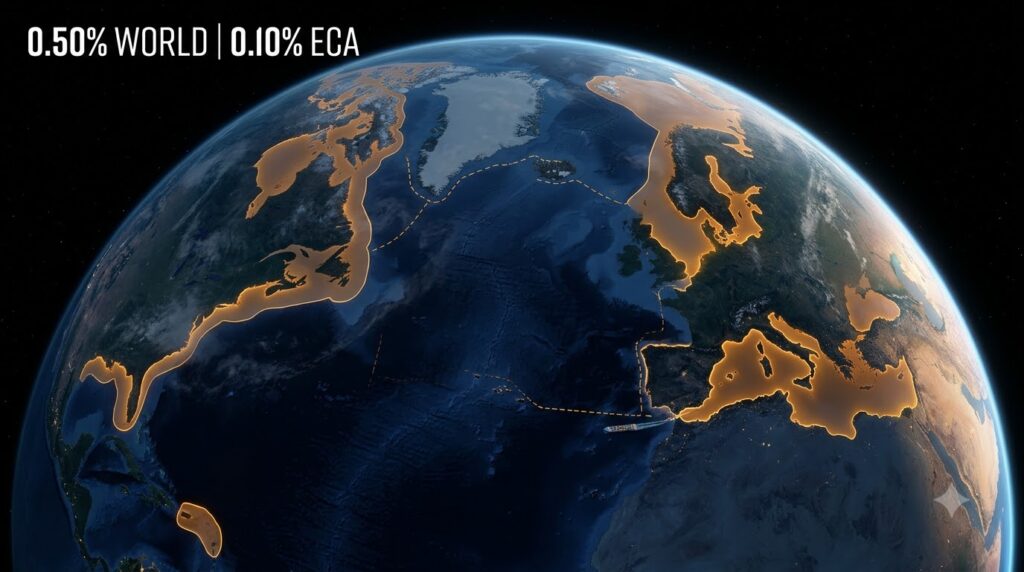
Picture a slowly rotating globe, oceans in navy blue and every ECA glowing amber. Here is what you would see, starting from home.
- Over the Indian Ocean. No amber at all. The Arabian Sea, Bay of Bengal and Indian coast fall under the 0.50% global cap. In fact, there is no MARPOL ECA anywhere in Asia, Africa, South America or Oceania.
- Through the Suez Canal. A ship leaving Port Said steps straight into amber. The whole Mediterranean has been an ECA since May 2025, so Asia–Europe ships now change over before Suez exit.
- Gibraltar and the Atlantic coast. Today the coast of Portugal, Spain and western France sits outside ECA. A dashed amber outline marks the North-East Atlantic ECA arriving in 2028.
- The English Channel, North Sea and Baltic. The oldest amber on the map. These waters have required 0.10% fuel since 2015.
- Up the Norwegian coast. The Norwegian Sea ECA is drawn but still pale; its sulphur limit starts in March 2027.
- Across to Greenland and the Canadian Arctic. Another pale zone for 2027, plus the 2028 Atlantic outline around Greenland and Iceland.
- Down the North American coast. A continuous amber band about 200 nm wide on the Atlantic, Gulf and Pacific coasts, plus Hawaii.
- Into the Caribbean. A small amber patch around Puerto Rico and the US Virgin Islands.
Zoom out once more and the pattern is clear. ECAs cluster around the North Atlantic. Once the North-East Atlantic ECA applies in 2028, a ship can sail from the Mediterranean to the Baltic, or on to Arctic Canada, without leaving 0.10% waters.
Local Rules That Look Like ECAs (But Are Not)
Some countries add their own limits. These are national or regional law, not MARPOL ECAs, and they can be stricter.
| Rule | Where | What it requires |
|---|---|---|
| EU at-berth rule | EU ports | 0.10% fuel at berth (EU Sulphur Directive 2016/802) |
| California rule | Within 24 nm of California | Distillate fuel at 0.10% (state regulation) |
| China domestic ECA | Chinese coastal waters and some inland rivers | National sulphur limits under Chinese law |
Requirements may vary and readers should verify the latest official notification before applying. Your company’s Safety Management System and the ship’s voyage instructions should list these local rules.
Does India Have an Emission Control Area?
No. As of October 2026, India has no MARPOL ECA. Indian ports and coastal waters follow the 0.50% global cap.
India applies Annex VI through DG Shipping circulars:
- Engineering Circular 02 of 2019 sets out how Indian ships, bunker suppliers and ports comply with the 0.50% cap and the carriage ban. It replaced Engineering Circular 5 of 2018.
- DGS Circular 02 of 2023 permits exhaust gas cleaning systems as an alternative means of compliance and sets out the procedure Indian ports follow.
Indian seafarers still deal with ECAs every week. Indian-crewed ships trade into the Mediterranean, North Europe and North America, and Indian officers serve across global fleets.
Three Ways a Ship Complies
| Option | How it works | Common onboard issue |
|---|---|---|
| Compliant fuel | VLSFO (≤0.50%) outside ECA; MGO or ULSFO (≤0.10%) inside | Changeover timing, viscosity and fuel compatibility |
| Scrubber (EGCS) | Burns HSFO and washes SOx out of exhaust | Washwater rules; some ports ban open-loop discharge |
| LNG or alternative fuel | Fuel with almost no sulphur | Bunkering availability, gas safety systems |
 Regulation 4 of Annex VI allows equivalents like scrubbers, if the flag State approves them. Many ships fitted with scrubbers still keep compliant fuel on board for ports that restrict washwater discharge.
Fuel Changeover Before Entering an ECA: What Happens On Board
This is where the regulation becomes an engine-room job. The rule is simple: the changeover must be complete before the ship crosses the ECA boundary, and it must be recorded.
A typical sequence, for a ship moving from VLSFO to MGO:
- Plan the time. The Chief Engineer works out how long the fuel system takes to flush through, based on service tank size, piping and consumption. Most ships use a written changeover procedure and a calculator sheet.
- Start early. The changeover begins hours before the boundary, using the ECA position from the voyage plan.
- Control temperature. Heated VLSFO and cool MGO differ a lot in temperature and viscosity. Many engine makers recommend limiting the rate of temperature change, often around 2 °C per minute. Always follow your engine maker’s instructions.
- Watch the pumps. Low-viscosity MGO can cause fuel pump wear or loss of injection pressure. Fuel coolers or chillers may be needed.
- Record it. Log the date, time, ship position and volume of compliant fuel in each tank when the changeover is complete.
Example: an Indian Third Engineer on a container ship from Nhava Sheva to Rotterdam via Suez. Before 2025, the first changeover happened near the English Channel. Since the Mediterranean ECA, it happens before Port Said exit, and the ship stays on 0.10% fuel for the whole Mediterranean passage. From 2028, the Atlantic leg off Portugal and Spain will be inside an ECA too.
Documents Port State Control Will Check

Port State Control officers often check sulphur compliance with paperwork first, then samples.
- IAPP Certificate and its supplement, showing the ship’s compliance method
- Bunker Delivery Notes (BDN), stating sulphur content, kept for three years
- MARPOL fuel sample from each bunkering, kept on board for at least 12 months
- Fuel changeover log with times, positions and tank quantities
- Ship Implementation Plan, prepared under IMO guidance MEPC.1/Circ.878 for IMO 2020
- FONAR (Fuel Oil Non-Availability Report) under Regulation 18, if compliant fuel genuinely could not be bought
A FONAR is not a free pass. It must show the ship tried to buy compliant fuel, and the port State decides how to treat it.
Why This Matters for Cadets and Indian Seafarers
- Engine cadets and junior engineers handle changeovers, sampling and tank soundings. Mistakes here lead to deficiencies, detentions and fines.
- Deck cadets and officers mark ECA boundaries on the voyage plan and ECDIS, and pass boundary times to the engine room.
- MEO Class 4 and Class 2 candidates regularly face oral questions on Regulation 14, the carriage ban, BDNs and scrubbers.
- ETOs often maintain scrubber control systems and emission monitoring equipment.
Knowing the full ECA map also helps when you choose a company or trade. Ships on North Atlantic routes spend much more time on 0.10% fuel than ships trading only in Asia.
Common Myths About the Sulphur Cap
- “India is in an ECA.” It is not. India follows the 0.50% global cap.
- “New ECAs apply from the entry-into-force date.” For sulphur, there is a 12-month exemption first. The Norwegian Sea and Canadian Arctic limits start on 1 March 2027, not 1 March 2026.
- “Scrubber ships can use HSFO anywhere.” Only where the equivalent is accepted. Some ports and coastal States ban open-loop washwater discharge.
- “The cap limits exhaust emissions.” It limits fuel sulphur content. Scrubbers are judged by an equivalent SO2/CO2 emission ratio.
Conclusion
The rule fits in one line: 0.50% sulphur anywhere, 0.10% inside an ECA. The map is what keeps changing. In October 2026, five ECAs are active, two more apply from March 2027, and the North-East Atlantic joins in September 2028.
For anyone heading to sea, learn the boundaries as well as the numbers. A correct changeover, a clean BDN and a complete log protect the ship, the company and your own licence.
Rules change through IMO amendments and DG Shipping circulars. Check the latest IMO and DG Shipping notifications before relying on any date for operations or exams.
13. FAQ section
Place this block on the page directly before the Conclusion, under the heading “Frequently Asked Questions”. The FAQ schema below uses these exact questions and answers.
1. What is the sulphur limit under MARPOL Annex VI? The limit is 0.50% m/m for fuel used anywhere outside Emission Control Areas, in force since 1 January 2020. Inside ECAs, the limit is 0.10% m/m.
2. How many Emission Control Areas are there in 2026? Five sulphur ECAs are active: Baltic Sea, North Sea, North American, US Caribbean and Mediterranean. The Norwegian Sea and Canadian Arctic ECAs are in force, with their 0.10% limit from 1 March 2027. The North-East Atlantic ECA is adopted and applies from 1 September 2028.
3. When did the Mediterranean become an ECA? The Mediterranean Sea ECA was adopted under resolution MEPC.361(79). Its 0.10% sulphur limit has applied since 1 May 2025.
4. When does the Norwegian Sea ECA sulphur limit apply? The Norwegian Sea and Canadian Arctic ECAs entered into force on 1 March 2026. After a 12-month exemption, the 0.10% sulphur limit applies from 1 March 2027.
5. Is India an Emission Control Area? No. India has no MARPOL ECA, so the 0.50% global sulphur cap applies in Indian waters and ports. DG Shipping enforces this through its circulars.
6. What is the MARPOL Annex VI carriage ban? Since 1 March 2020, ships may not carry fuel above 0.50% sulphur for their own use unless they have an approved equivalent, such as a scrubber. Fuel carried as cargo is exempt.
7. Can a ship with a scrubber use high-sulphur fuel in an ECA? Yes, if the flag State has approved the scrubber as an equivalent under Regulation 4. Some ports and coastal States restrict open-loop washwater discharge, so ships may still need compliant fuel there.
8. When must fuel changeover be completed before entering an ECA? The changeover to 0.10% fuel must be fully complete before the ship enters the ECA. The date, time, position and compliant fuel quantity must be recorded in the logbook.
9. What is a FONAR? A Fuel Oil Non-Availability Report, under Regulation 18, tells authorities a ship could not buy compliant fuel despite trying. It is not an automatic exemption; the port State decides how to treat it.
10. What is the difference between VLSFO, ULSFO and MGO? VLSFO has up to 0.50% sulphur and is used outside ECAs. ULSFO and MGO meet the 0.10% limit and are used inside ECAs.
11. Is MARPOL Annex VI asked in MEO Class 4 orals? Yes, Annex VI and Regulation 14 are common topics in MEO oral exams. Expect questions on the sulphur limits, ECAs, changeover, BDNs, the carriage ban and scrubbers.

Pingback: Ship Incinerator: How Ships Burn Sludge Oil & Garbage - Fleet Frontier