What Is a Marine Diesel Engine? Types, Working and Parts Explained
Last Updated: October 2026
By V.K. Singh | Fleet Frontier
A marine diesel engine is the engine that drives a ship’s propeller or produces the ship’s electricity. It is a compression-ignition engine: air is squeezed until it is hot enough to ignite the fuel, with no spark plug involved. Nearly every container ship, bulk carrier and tanker you will join as an Indian cadet uses diesel engines, whether as the main propulsion engine, as generator engines, or both.
This guide covers how a marine diesel engine works, the difference between two-stroke and four-stroke engines, the main parts and systems, the fuels used in 2026, current IMO emission rules, and why this knowledge matters for students and engine cadets.

Quick Answer
What is a marine diesel engine?
A marine diesel engine is a compression-ignition internal combustion engine used on ships for propulsion and power generation. Air is compressed in the cylinder until it becomes very hot, fuel is injected, and it ignites on its own. Large ships mostly use slow-speed two-stroke engines for propulsion and medium-speed four-stroke engines for generators.
Why Do Ships Use Diesel Engines?
Diesel engines became the standard prime mover in merchant shipping for practical reasons:
- High thermal efficiency. Large two-stroke engines are among the most fuel-efficient heat engines ever built. Fuel is the biggest operating cost of a ship, so this matters a great deal.
- Ability to burn heavy fuels. Marine engines can run on residual fuels that are cheaper than road diesel, once the fuel is heated and cleaned onboard.
- Reliability over long voyages. A main engine may run continuously for weeks between ports.
- Direct drive. A slow-speed engine turns at roughly the speed a large propeller needs, so it can be coupled to the propeller shaft with no gearbox.
- Simple, robust design. Diesel engines have no ignition system, and engine crews worldwide are trained to maintain them.
Steam turbines once dominated large ships, and gas turbines are used in some naval and specialised vessels. For commercial cargo ships, however, diesel engines took over because they burn much less fuel.
How Does a Marine Diesel Engine Work?
Every diesel engine follows the same basic cycle, whether it powers a lifeboat or a 20,000 TEU container ship.
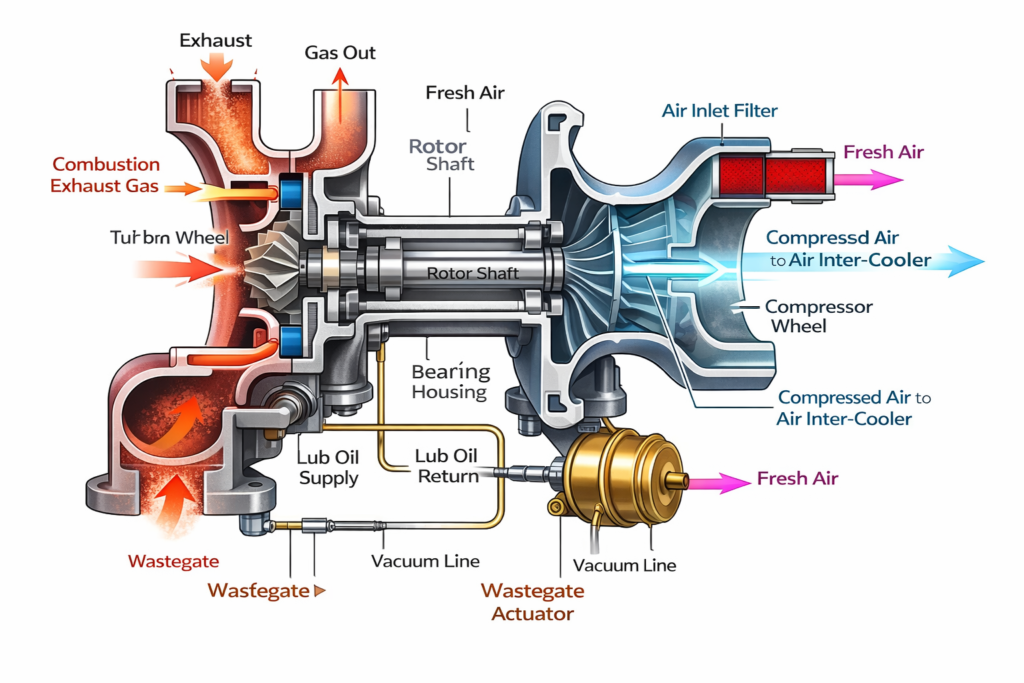
- Air intake (scavenging/suction): Fresh air enters the cylinder. On ships it is usually pressurised by a turbocharger, which pushes more air in so more fuel can be burned.
- Compression: The piston moves up and compresses the air. Its temperature rises well above the fuel’s self-ignition point.
- Fuel injection and combustion: Near the top of the stroke, fuel is injected as a fine spray. It ignites from the hot air alone, and the expanding gas pushes the piston down. This is the power stroke.
- Exhaust: Burnt gases leave the cylinder and drive the turbocharger on their way to the funnel.
The piston’s up-and-down motion is converted into rotation by the connecting rod and crankshaft. That rotation turns the propeller shaft or the alternator.
The key point: a petrol engine needs a spark, while a diesel engine needs only compression. This is why marine engineers talk about compression pressure, peak pressure and fuel injection timing so often. These three parameters show how healthy each cylinder is.
Types of Marine Diesel Engines
Marine diesel engines are usually classified by operating cycle (two-stroke or four-stroke) and by speed.
Classification by Speed
| Type | Typical RPM | Common Use Onboard |
|---|---|---|
| Slow-speed | Below ~300 rpm (large engines often under 130 rpm) | Main propulsion on large cargo ships |
| Medium-speed | ~300–1,000 rpm | Generators, main engines of ferries, offshore vessels, cruise ships |
| High-speed | Above ~1,000 rpm | Lifeboats, rescue boats, emergency generators, small craft |
These ranges are general industry descriptions and are not fixed regulatory limits. Manufacturers and textbooks draw the lines slightly differently.
Two-Stroke Marine Diesel Engine
A two-stroke engine completes one full cycle in two strokes of the piston, which means one crankshaft revolution. Every downward stroke is a power stroke.
On large merchant ships, the main engine is almost always a slow-speed, two-stroke, crosshead-type engine with:
- Uniflow scavenging: Air enters through ports at the bottom of the liner, and exhaust leaves through a single exhaust valve in the cylinder cover.
- Crosshead design: A piston rod connects the piston to a crosshead, which then connects to the connecting rod. This separates the cylinder from the crankcase, so the cylinder and the bearings can use different lubricating oils.
- Direct coupling to the propeller: No reduction gearbox is needed.
- Direct reversing: The engine can run astern by changing its timing, so many installations need no reversing gear.
The best-known two-stroke designs at sea today come from MAN B&W and WinGD. Shipyard-linked licensees build them, mainly in Korea, China and Japan.
Four-Stroke Marine Diesel Engine
A four-stroke engine needs four piston strokes (intake, compression, power, exhaust), which take two crankshaft revolutions, for one power stroke. It uses inlet and exhaust valves and a trunk piston, meaning the connecting rod attaches directly to the piston and there is no crosshead.
Onboard, four-stroke engines typically serve as:
- Auxiliary engines (diesel generators/gensets) supplying the ship’s electrical power
- Main engines on smaller ships, tugs, ferries and offshore support vessels, usually through a gearbox
- Prime movers in diesel-electric ships such as many cruise ships and some offshore vessels, where generators feed electric propulsion motors
Two-Stroke vs Four-Stroke: Quick Comparison
| Feature | Two-Stroke (Main Engine) | Four-Stroke (Auxiliary/Medium-Speed) |
|---|---|---|
| Power strokes | Every revolution | Every second revolution |
| Speed | Slow | Medium to high |
| Piston type | Crosshead | Trunk piston |
| Gas exchange | Scavenge ports + exhaust valve | Inlet + exhaust valves |
| Size | Very large, often several storeys high | Compact |
| Typical role | Propulsion of large ships | Generators, smaller ships |
| Lubrication | Separate cylinder oil + system oil | Single oil for cylinder and crankcase |
Main Parts of a Marine Diesel Engine
You will memorise these parts for written exams, orals and your first engine-room familiarisation.
Structural Parts
- Bedplate: The foundation of the engine. It holds the main bearings.
- A-frames / Columns: Mounted on the bedplate to support the cylinder block and carry the crosshead guides.
- Cylinder block (entablature): Houses the cylinder liners and the scavenge air space.
- Tie rods: Long bolts that hold the bedplate, frames and cylinder block together in compression. They are a feature of large two-stroke engines.
Running Gear
- Piston and piston rings: Seal the combustion space and transmit gas force.
- Piston rod and crosshead (two-stroke only)
- Connecting rod: Links the crosshead or piston to the crankshaft.
- Crankshaft: Converts reciprocating motion into rotation.
- Main bearings, crankpin bearings and crosshead bearings
Combustion Space
- Cylinder liner: The replaceable inner surface of the cylinder.
- Cylinder cover (cylinder head): Holds the fuel injectors, the exhaust valve and the starting air valve.
- Exhaust valve: Often hydraulically operated on modern two-stroke engines.
Air and Exhaust
- Turbocharger: An exhaust gas turbine drives a compressor that supplies charge air.
- Scavenge air cooler: Cools the compressed air so it is denser.
- Auxiliary blowers: Supply air at low load, when the turbocharger alone is not enough.
Fuel and Control
- Fuel pumps and fuel injectors
- Governor: Controls engine speed.
- Camshaft: Found on conventional engines. Electronically controlled engines replace mechanical cam timing with hydraulic and electronic control.
Essential Engine Systems Onboard
An engine is only as good as the systems that feed it. Cadets spend much of their time on these:
| System | What It Does | What You’ll Do as a Cadet |
|---|---|---|
| Fuel oil system | Transfers, heats, cleans (with separators/purifiers) and supplies fuel at the right viscosity | Take soundings, assist purifier cleaning, record temperatures |
| Lubricating oil system | Lubricates bearings, cools pistons (system oil) and lubricates liners (cylinder oil on two-strokes) | Check sump levels, filter cleaning, oil sampling |
| Cooling water system | Removes heat from the jacket, air coolers and lube oil, usually via a central fresh water system cooled by seawater | Monitor jacket water temperature, check expansion tank, chemical tests |
| Starting air system | Compressed air (commonly around 30 bar) turns the engine to start it | Drain air bottles, run compressors |
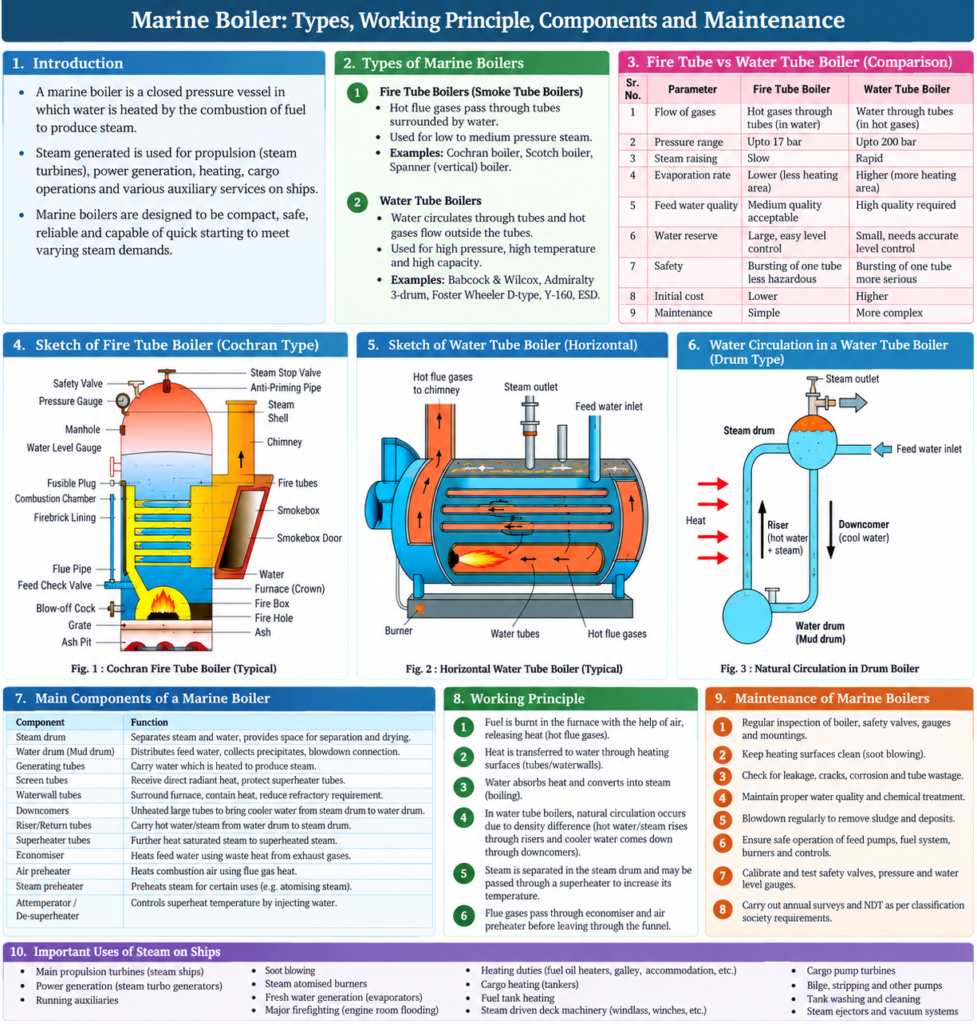
| Scavenge and exhaust system | Supplies combustion air and removes exhaust gas, often via an exhaust gas boiler | Scavenge space inspection, drain checks |
Real shipboard example: Before a ship sails, the engine room “prepares the main engine.” Jacket water is warmed up, lube oil and cooling pumps are started, the turning gear rotates the engine slowly while indicator cocks are open, and the engine is given an air blow to clear any water or oil from the cylinders. Cadets often stand next to the Second or Third Engineer during this routine, and it is one of the best ways to learn the engine.
What Fuels Do Marine Diesel Engines Use in 2026?
Ship fuels have changed significantly in recent years, mainly because of air pollution rules.
| Fuel | Description | Typical Use |
|---|---|---|
| VLSFO (Very Low Sulphur Fuel Oil) | Max 0.50% sulphur | Most ships worldwide since 2020 |
| HSFO (High Sulphur Fuel Oil) | Heavy fuel oil | Only on ships with approved exhaust gas cleaning systems (scrubbers) |
| MGO / ULSFO | Distillate or ultra-low sulphur fuel | Inside Emission Control Areas, generators, manoeuvring |
| LNG | Liquefied natural gas | Dual-fuel engines on newer ships |
| Methanol | Alternative fuel | Dual-fuel engines on a growing number of newbuildings |
| Ammonia | Zero-carbon fuel candidate | Early-stage engines and pilot projects |
Dual-fuel engines can burn both conventional fuel oil and a gaseous or alternative fuel. This is becoming one of the most important skills areas for future marine engineers.
Marine Diesel Engine Emission Rules (IMO MARPOL Annex VI)
Marine engines are regulated internationally by the International Maritime Organization (IMO) under MARPOL Annex VI. India’s maritime regulator implements these rules for Indian ships.
Sulphur Limits
- The global 0.50% sulphur limit for ships’ fuel oil entered into force on 1 January 2020 under MARPOL Annex VI Regulation 14.
- While a ship operates within a SOx Emission Control Area, the sulphur content of the fuel oil used onboard must not exceed 0.10% m/m.
- The Mediterranean Sea became a SOx ECA effective 1 May 2025.
NOx Limits (Tier I, II, III)
The NOx requirements of Annex VI apply to installed marine diesel engines of over 130 kW output, other than engines used solely for emergencies, irrespective of the ship’s tonnage.
| Tier | Ships Constructed On/After | Where It Applies |
|---|---|---|
| Tier I | 1 January 2000 | Globally |
| Tier II | 1 January 2011 | Globally |
| Tier III | 1 January 2016 | Only inside NOx Emission Control Areas |
Tier III applies to ships built on or after 1 January 2016 when operating in the North American and US Caribbean Sea ECAs, and to ships built on or after 1 January 2021 when operating in the Baltic Sea or North Sea ECAs. Outside such areas, Tier II controls apply. To meet Tier III, engines use technologies such as Selective Catalytic Reduction (SCR) or Exhaust Gas Recirculation (EGR).
Each engine’s NOx compliance is certified with an EIAPP Certificate and an approved Technical File kept onboard.
Greenhouse Gas Rules: What’s Pending
In October 2025, the IMO voted to defer the formal adoption of its Net-Zero Framework by one year, rescheduling the vote for October 2026. The outcome will strongly influence which fuels and engine types ships adopt over the next decade. Readers should check the IMO website for the latest decision.
Main Engine vs Auxiliary Engine
| Point | Main Engine | Auxiliary Engine |
|---|---|---|
| Purpose | Propels the ship | Generates electricity |
| Typical type | Two-stroke slow-speed | Four-stroke medium-speed |
| Number onboard | Usually one (sometimes two) | Usually three or more generators |
| Runs in port? | No | Yes, powers the ship in port |
| Common cadet task | Readings, scavenge inspection | Overhauls, decarbonisation, routine checks |
Many cadets get their first serious “hands-on” engine experience on auxiliary engines. Overhauling a generator unit (pulling a piston, measuring liner wear, checking bearing clearances) teaches the same principles used on the main engine, at a manageable scale.
Common Problems Engineers Watch For
Experienced engineers learn to “read” a diesel engine through its parameters and sounds. Common issues covered in training and MEO exam preparation include:
- Scavenge fires: Caused by oil and carbon build-up in the scavenge space of two-stroke engines.
- Crankcase explosions: Prevented through oil mist detectors, relief valves and good bearing maintenance.
- Liner and ring wear: Influenced by cylinder oil feed rate and fuel quality.
- Turbocharger surging and fouling
- Poor combustion: Shown by high exhaust temperatures, black smoke or low peak pressure.
- Fuel quality problems: Such as cat fines, incompatibility or instability. These became more common after the switch to blended low-sulphur fuels.
Why This Topic Matters for Indian Merchant Navy Students
Understanding the marine diesel engine is not optional for engine-side careers.
- B.Tech Marine Engineering and GME students study diesel engines as a core subject. It forms the foundation of later competency exams.
- Engine cadets complete practical training tasks on main and auxiliary engines during sea time.
- MEO Class IV, Class II and Class I competency examinations, conducted under India’s maritime administration, test motor knowledge in written and oral rounds. Check the regulator’s latest notifications for exam structure and eligibility.
- ETOs work closely with engine automation, alarm systems, governors and electronically controlled engines.
- Deck officers need to understand engine limits, manoeuvring speeds and emergency procedures from the bridge side.
- GP Ratings in the engine department (wipers, motormen, oilers) assist directly with engine maintenance and watchkeeping.
Regulator update: India’s apex maritime regulator, the Director-General of Shipping (DGS), was renamed the Director-General of Maritime Administration (DGMA) in June 2026, under Section 7 of the Merchant Shipping Act, 2025. Official circulars and exam notices are now published by the DGMA. Always verify the latest notification before applying for courses or exams.
How Big Is a Marine Diesel Engine?
The largest two-stroke main engines on big container ships and VLCCs are several storeys tall, weigh well over a thousand tonnes, and can have cylinder bores close to a metre wide. A single piston can be big enough for a person to stand inside the cylinder liner during inspection. In contrast, a lifeboat engine may be small enough to fit under a seat.
Exact dimensions depend on the specific engine model. Refer to manufacturer data for figures.
Future of Marine Diesel Engines
The diesel engine is not disappearing soon, but it is evolving:
- Dual-fuel engines (LNG, methanol, ammonia) are being built into newbuildings.
- Electronically controlled engines have replaced mechanical camshafts on many new ships.
- Hybrid systems with batteries are being added for port operations and peak loads.
- Digital monitoring and condition-based maintenance are becoming standard.
For today’s students, this means classic diesel knowledge plus alternative fuels, automation and safety skills will define the engineers companies want in the coming decade.
Conclusion
A marine diesel engine is the working heart of almost every merchant ship. It converts the energy in fuel into the power that moves cargo across oceans and keeps the lights on onboard. Large ships rely on slow-speed two-stroke engines for propulsion and four-stroke engines for electricity. Both are now shaped by strict IMO emission rules and a gradual shift to cleaner fuels.
If you are planning a career in marine engineering, start learning the basics now: the four-stroke cycle, the two-stroke uniflow principle, the main parts, and the supporting systems. That foundation will help you through college exams, your cadetship, and eventually your MEO competency certificates.
Requirements may vary. Readers should verify the latest official notification from the DGMA or IMO before relying on regulatory details.
13. FAQ SECTION
1. What is a marine diesel engine in simple words?
It is a ship engine that burns fuel using compression heat instead of a spark. It drives the propeller or generates electricity onboard.
2. Which engine is used in large merchant ships?
Most large cargo ships use a slow-speed, two-stroke, crosshead diesel engine connected directly to the propeller.
3. What is the difference between a 2-stroke and 4-stroke marine engine?
A two-stroke engine produces a power stroke every revolution and is used mainly for propulsion. A four-stroke engine produces one every two revolutions and is commonly used for generators.
4. Why are two-stroke engines used for ship propulsion?
They are highly fuel-efficient, can burn heavy fuels, and run at low speeds suited to large propellers without needing a gearbox.
5. What fuel do ships use today?
Most ships use very low sulphur fuel oil (max 0.50% sulphur). Ships with scrubbers may use high-sulphur fuel, and newer ships may run on LNG or methanol in dual-fuel engines.
6. What is an auxiliary engine on a ship?
An auxiliary engine is usually a four-stroke diesel generator that supplies electrical power for machinery, lighting and accommodation, both at sea and in port.
7. What is the RPM of a ship’s main engine?
Large slow-speed main engines often run below about 130 rpm, although this varies by engine model and ship.
8. What is a crosshead engine?
It is an engine where the piston connects to the connecting rod through a piston rod and crosshead. This separates the cylinder from the crankcase and is typical of large two-stroke engines.
9. What are IMO Tier III NOx limits?
Tier III is the strictest IMO NOx standard. It applies to engines on ships built from 2016 (or 2021 for Baltic and North Sea) when operating inside NOx Emission Control Areas.
10. Do engine cadets work on the main engine?
Yes. Engine cadets assist with main and auxiliary engine maintenance, readings and inspections under supervision as part of structured onboard training.
11. Is marine diesel engine knowledge needed for MEO exams?
Yes. Motor knowledge is a key part of MEO competency examinations in India. Check DGMA notifications for the current syllabus and exam pattern.