
Marine Boiler: Types, Working Principle, Components and Maintenance
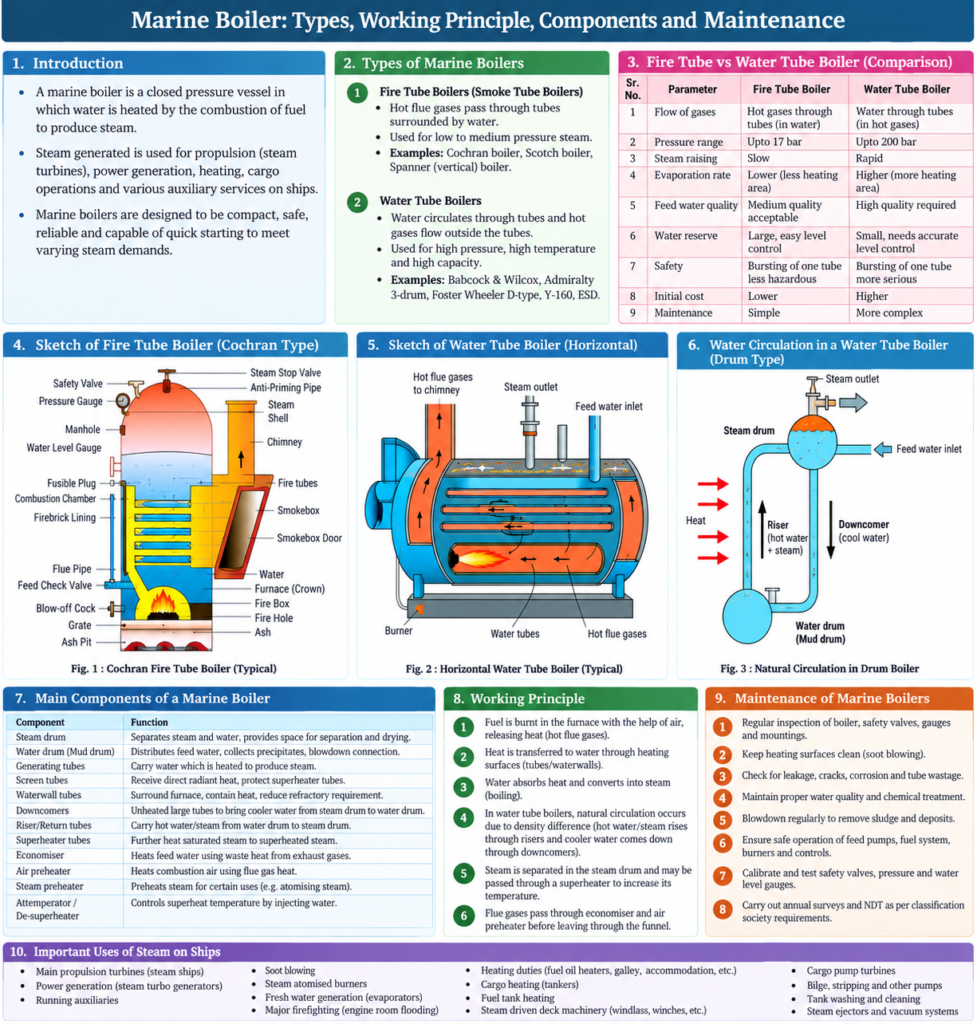
A marine boiler is a closed pressure vessel in which feed water is heated by the combustion of fuel to generate steam. The steam is used for propulsion, power generation, heating, soot blowing and various auxiliary services onboard ships.
1. Types of Marine Boilers
Marine boilers are mainly classified into:
A. Fire-Tube / Smoke-Tube Boiler
In a fire-tube boiler, hot combustion gases pass through tubes surrounded by water.
Examples:
- Cochran boiler
- Scotch boiler
- Spanner vertical boiler
These are generally used for low-pressure steam and auxiliary purposes.
B. Water-Tube Boiler
In a water-tube boiler, water flows through tubes which are heated externally by hot gases.
Examples:
- Foster Wheeler D-type
- ESD boilers
- Other high-pressure water-tube designs
They are suitable for high-pressure, high-capacity steam generation.
2. Simple Sketch of Marine Water-Tube Boiler


1. Steam Drum
- Located at the upper part of the boiler.
- Separates steam from water.
- Provides space for steam-water separation.
- Separating devices remove water droplets from steam.
2. Water Drum / Mud Drum
- Located below the steam drum.
- Distributes water to generating tubes and headers.
- Collects precipitated sludge/deposits.
- Blowdown connection is normally fitted here.
3. Generating Tubes
- Connect the steam and water circulation system.
- Carry water/steam-water mixture through the heated gas-flow area.
- Provide the main heating surface for steam generation.
4. Water-Wall Tubes
- Surround the furnace.
- Absorb radiant heat from the furnace.
- Reduce the amount of refractory and insulation required.
- May be arranged as membrane walls.
5. Downcomers
- Large-diameter, unheated tubes.
- Carry relatively cool water from the steam drum to the water drum.
- Maintain positive water circulation.
6. Riser / Return Tubes
- Carry the hot water/steam mixture from the heated sections back toward the steam drum.
7. Screen Tubes
- Receive radiant heat from the furnace.
- Protect the superheater tubes from excessive direct radiation.
8. Superheater
- Further heats saturated steam.
- Produces superheated steam for use by steam turbines.
- Removes remaining moisture from the steam.
9. Economizer
- Uses heat from exhaust/flue gases to preheat feed water.
- Improves boiler efficiency.
- Reduces thermal shock when feed water enters the steam drum.
10. Safety Valves
- Protect the boiler against excessive steam pressure.
- Automatically release steam when pressure exceeds the permitted limit.
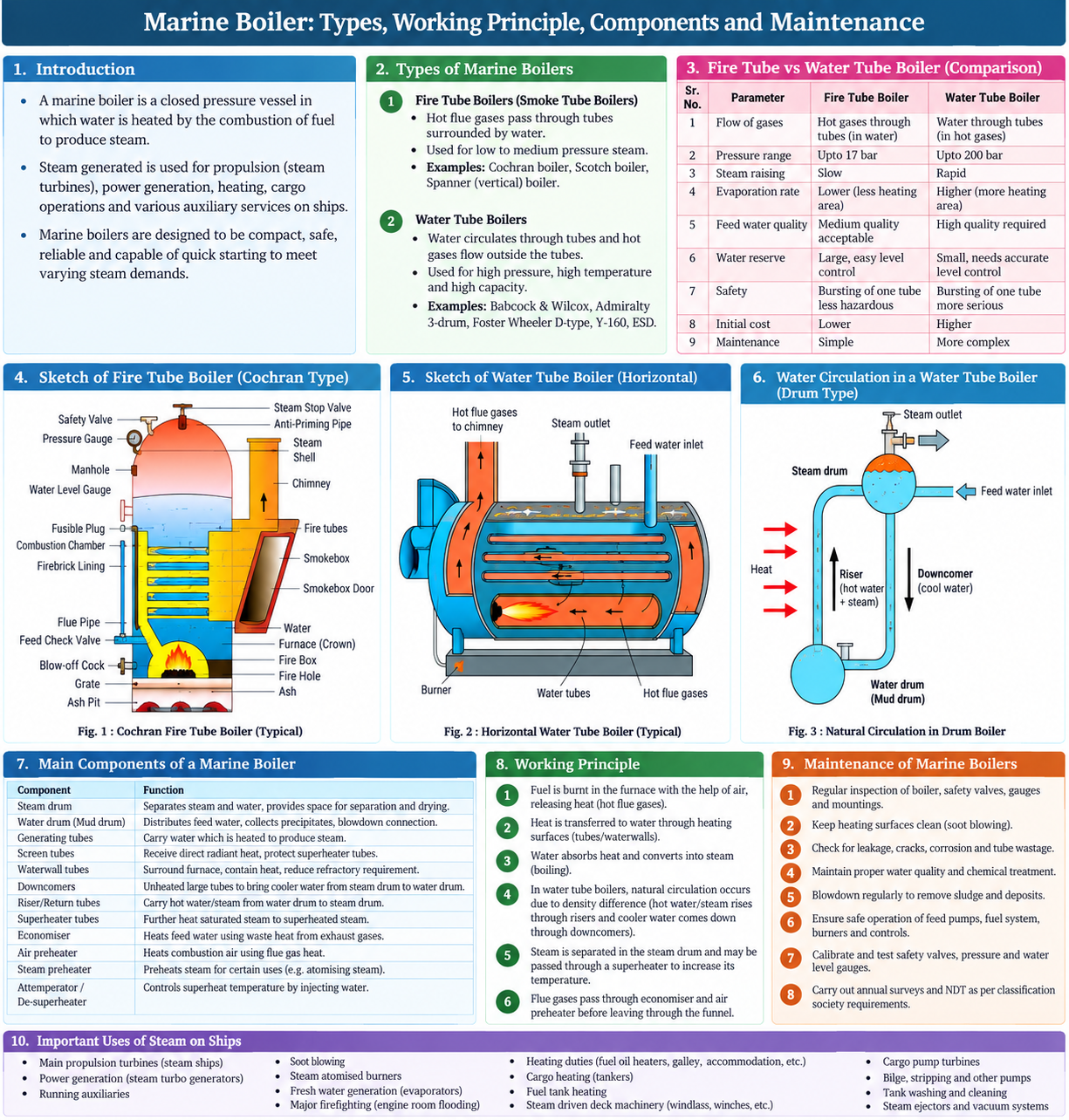
4. Working Principle – Step by Step
Step 1 – Fuel Burning
Fuel oil is supplied to the burner and burned inside the furnace with adequate air.
Step 2 – Heat Production
Combustion produces high-temperature flue gases.
Step 3 – Heat Transfer
Heat is transferred from the hot gases to the water through the furnace water walls, generating tubes and other heating surfaces.
Step 4 – Water Circulation
In a water-tube boiler, relatively cool water moves downward through the downcomers.
Heated water and steam-water mixture rise through the generating/riser tubes due to natural circulation.
Step 5 – Steam Separation
The steam-water mixture enters the steam drum, where water and steam are separated.
Step 6 – Superheating
Saturated steam may pass through the superheater, where its temperature is increased and moisture is removed.
Step 7 – Steam Supply
The resulting superheated steam leaves the boiler and is supplied to the required machinery/system.
Flow Summary
Fuel + Air → Furnace → Hot gases → Heating surfaces → Water heated → Steam drum → Superheater → Steam outlet
5. Important Boiler Mountings
Common important mountings include:
- Safety valves
- Main steam stop valve
- Water level gauge
- Pressure gauge
- Feed check valve
- Blowdown valve
- Air vent
- Manhole and inspection doors
- Scum/blowdown arrangements
- Low-water alarm and shutdown systems
These fittings and controls ensure that fuel, air and feed-water supply are matched to steam demand and that the boiler operates safely.
6. Marine Boiler Maintenance
Proper maintenance is essential because boilers operate at high pressure and high temperature.
A. Water-Side Maintenance
- Maintain correct boiler-water level.
- Carry out regular blowdown to remove sludge and deposits.
- Maintain proper feed-water treatment.
- Check for scale and corrosion.
- Inspect drums, headers and tubes.
B. Fire-Side Maintenance
- Keep heating surfaces clean.
- Carry out regular soot blowing.
- Remove carbon deposits and soot.
- Inspect furnace and refractory.
- Check burners and flame condition.
The presentation specifically emphasizes efficient sootblowing because deposits can reduce efficiency, increase corrosion and, particularly in economizers, contribute to the risk of fires.
C. Tube Inspection
Check for:
- Tube leakage
- Cracks
- Corrosion
- Erosion
- Tube wastage
- Overheating
D. Safety Equipment
Regularly inspect and test:
- Safety valves
- Pressure gauges
- Water-level indicators
- Alarms
- Shutdown devices
E. Periodic Testing
Boilers may undergo:
- Ultrasonic Testing (UT)
- Radiographic Testing (RT)
- Magnetic Particle Inspection (MPI)
- Dye Penetrant Testing (DPT)
- Hydrostatic pressure testing
The uploaded material states that hydraulic testing of boilers is carried out at 1.5 times the design pressure as part of structural verification.
7. Fire-Tube vs Water-Tube Boiler
| Feature | Fire-Tube Boiler | Water-Tube Boiler |
|---|---|---|
| Flow inside tubes | Hot gases | Water/steam |
| Pressure | Low/medium | High |
| Steam generation | Relatively slow | Rapid |
| Water content | Large | Comparatively small |
| Feed-water quality | Less stringent | More stringent |
| Application | Auxiliary steam | High-capacity/high-pressure steam |
| Examples | Cochran, Scotch | Foster Wheeler D-type, ESD |
8. Uses of Steam on Ships
Steam generated by marine boilers can be used for:
- Main propulsion turbines
- Steam turbo-generators
- Fuel-oil heating
- Cargo heating
- Feed-water heating
- Soot blowing
- Steam-atomized burners
- Fresh-water generation
- Tank cleaning
- Cargo pump turbines
- Steam-driven pumps
- Deck machinery
By: Fleetfrontier