
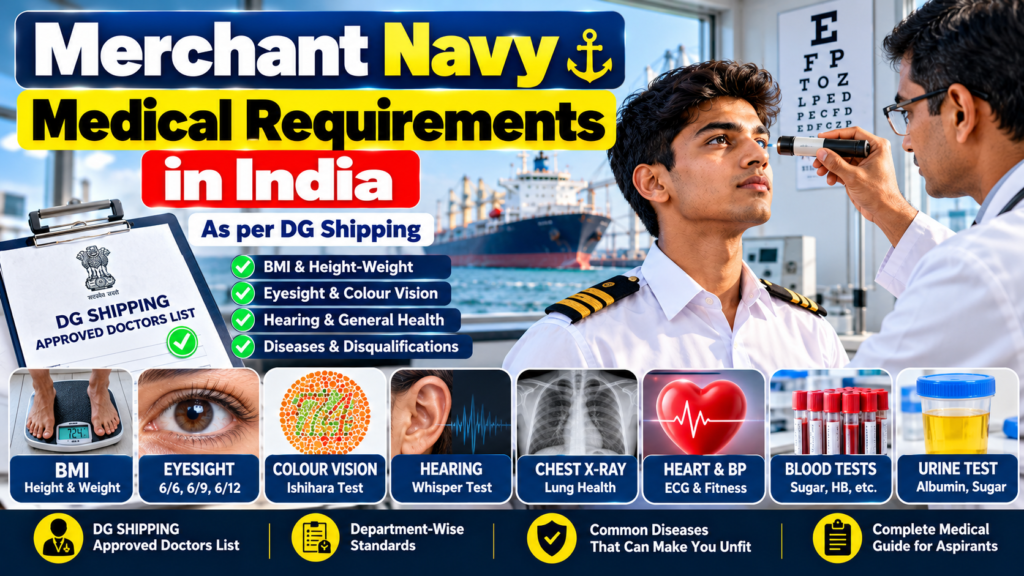
What Are the Medical Requirements for Merchant Navy? DG Shipping Medical Standards 2026
What Are the Medical Requirements for Merchant Navy?
Medical fitness is one of the most important requirements for joining the Merchant Navy in India. Before starting sea training or joining a vessel, candidates and seafarers must satisfy the applicable medical fitness standards.
The medical examination checks whether a person can safely perform routine duties, emergency duties and safety-critical work onboard a ship. The examination includes physical fitness, eyesight, colour vision, hearing, cardiovascular health, respiratory health and other medical conditions.
For Indian seafarers, the Directorate General of Shipping (DG Shipping/DGMA), Government of India maintains the medical framework and an official register of approved Medical Examiners. The official medical examiner register currently provides approved doctors authorised to conduct medical examinations of seafarers.
Important: Medical standards can differ according to the department—Deck, Engine, ETO, Catering/General Purpose—and the type of duty. A candidate should always obtain the final fitness decision from a currently approved DG Shipping Medical Examiner.
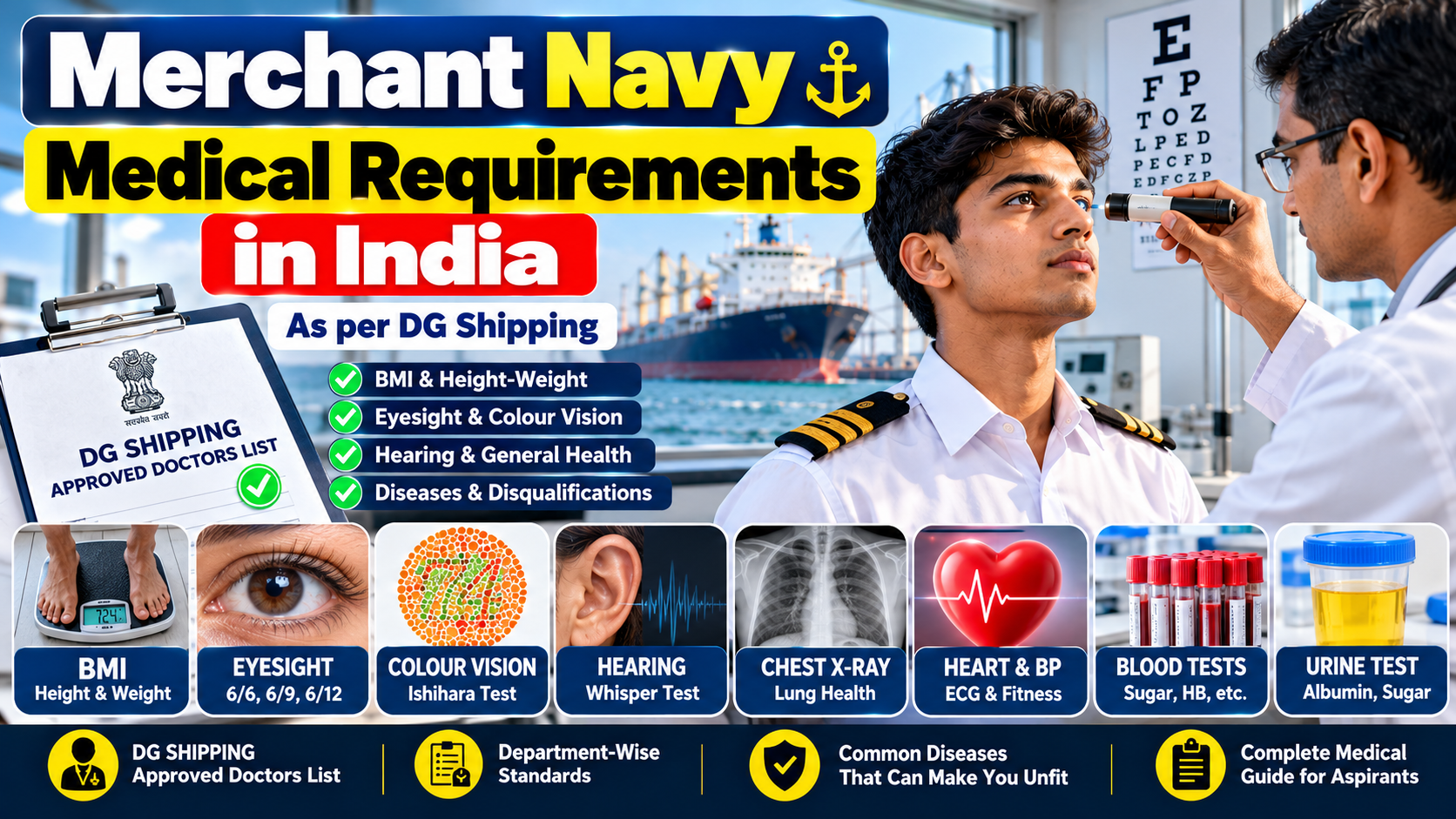
Quick Overview of Merchant Navy Medical Requirements
| Medical Parameter | What Is Checked? |
|---|---|
| Height & Weight | Physical development and proportion |
| BMI | Weight relative to height; may indicate need for further assessment |
| Eyesight | Distance and near vision |
| Colour Vision | Ishihara/approved colour vision testing |
| Eye Health | Squint, visual field, eye disease, binocular vision |
| Hearing | Ability to hear speech/whisper and audiometry where required |
| Blood Pressure | Cardiovascular fitness |
| Heart | ECG/other investigations when indicated |
| Lungs | Chest examination, X-ray and other tests when required |
| Blood Tests | Haemoglobin, blood sugar and other investigations |
| Urine | Sugar, albumin and other parameters |
| Infectious Diseases | Relevant screening based on examination/requirements |
| Physical Fitness | Ability to perform normal and emergency duties |
| Neurological Health | Seizures, epilepsy, dizziness, fainting, etc. |
| Mental Health | Conditions affecting safe performance |
| Musculoskeletal System | Limbs, spine, movement and physical capability |
| Drug/Alcohol Testing | May be required by employer/institute |
DG Shipping medical documentation includes assessment of height, weight, blood pressure, vision, colour vision, hearing and systemic health, with additional diagnostic tests where required.
1. Who Can Conduct a Merchant Navy Medical Examination?
A Merchant Navy medical certificate should be obtained from a Medical Examiner approved by DG Shipping/DGMA.
The Directorate maintains an official register of approved Medical Examiners and provides details such as the examiner’s approval number, name, qualification, examination location and registration validity.
Do not simply visit an ordinary local doctor and assume that the certificate will be accepted for Merchant Navy purposes.
How to verify a doctor
Before booking your medical examination:
- Check the doctor’s name in the official DGMA/DG Shipping list.
- Check the DGS Approval Number.
- Check the examination location.
- Check the validity of the approval/medical council registration.
- Confirm that the doctor is currently authorised to conduct seafarer medical examinations.
The official eSamudra portal also provides a Registered Medical Practitioners / DGS Approved Medical Practitioners directory.
Official DG Shipping/DGMA Approved Doctor List
Official Medical Examiner Register:
DGMA – Register of Approved Medical Examiners of Seafarers
The official register is preferable to copying an old doctor list into a blog because doctors can be added, removed, suspended or have registration validity updated.
The DGMA page also publishes a suspended doctors list, so candidates should check both the regular and suspended lists before booking a medical.
2. Height and Weight Requirements for Merchant Navy
Height and weight are checked during the medical examination.
The published DG Shipping medical standards for new entrants specify:
- Male: minimum height around 157 cm
- Female: minimum height around 152 cm
- Minimum weight requirements are also specified, with weight expected to be proportionate to height.
The older detailed standards specify 48 kg for males and 45 kg for females alongside the height requirements. However, medical fitness is not determined by weight alone; proportionality and overall physical fitness are important.
Does height matter for every Merchant Navy job?
The applicable standard can depend on the candidate’s category, department and current regulatory requirements.
Therefore, candidates should not assume that a single height or weight number automatically determines fitness.
3. BMI Requirement for Merchant Navy
BMI means Body Mass Index.
It is calculated using:
BMI = Weight (kg) ÷ Height² (metres)
For example:
A candidate weighs 70 kg and is 1.75 m tall.
BMI:
70 ÷ (1.75 × 1.75) = 22.86
BMI can help the medical examiner understand whether the candidate’s body weight may require additional assessment.
Is there one fixed DG Shipping BMI limit?
This is an important point for Merchant Navy aspirants.
There is a lot of information online claiming that “BMI must be exactly 18.5–25” or “BMI above 30 means automatic rejection.” Candidates should be careful with such statements.
The current medical framework focuses on overall medical fitness and the ability to safely perform shipboard duties, rather than using BMI as the only factor. Official medical material also records height and weight during examination.
A high or low BMI can become important when it is associated with:
- Poor exercise tolerance
- Reduced mobility
- Hypertension
- Diabetes
- Cardiovascular problems
- Breathing problems
- Other medical complications
Therefore, high BMI does not automatically mean permanent rejection in every case. The approved Medical Examiner makes the fitness assessment based on the complete medical picture.
Practical advice for candidates
If you are overweight or underweight, do not try to manipulate your weight immediately before the examination.
Instead:
- Maintain a healthy diet.
- Exercise regularly.
- Sleep properly.
- Check your blood pressure.
- Check blood sugar if advised.
- Get a medical evaluation before the official examination.
4. Merchant Navy Eyesight Requirements
Eyesight is one of the most important parts of the Merchant Navy medical examination.
The requirements are different for different departments.
According to the published Indian pre-sea medical standards, the following distance-vision standards apply.
| Department | Unaided Distance Vision |
|---|---|
| Deck Department | 6/6 in better eye + 6/9 in other eye |
| Engine Department | 6/12 in each eye OR 6/9 in better eye + 6/18 in other eye |
| Catering Department | 6/18 in each eye OR 6/12 in better eye + 6/24 in other eye |
| ETO / Electrical-Electronic / Radio-related duties | 6/12 in each eye OR 6/9 in better eye + 6/18 in other eye |
The standards also require good binocular vision and healthy eyes.
5. What Does 6/6, 6/9 and 6/12 Eyesight Mean?
Many students become confused by these numbers.
6/6 vision
This represents standard normal distance visual acuity.
6/9 vision
A person with 6/9 vision sees at 6 metres what a person with standard 6/6 vision can see at 9 metres.
6/12 vision
A person with 6/12 vision sees at 6 metres what a person with 6/6 vision can see at 12 metres.
The important point is that Merchant Navy medical requirements are based on measured visual acuity, not simply the spectacle power written on your prescription.
6. Is Spectacle Power Allowed in Merchant Navy?
This is one of the most searched questions by Merchant Navy aspirants.
The answer depends on the department, type of examination and applicable standard.
For example, the published pre-sea standards specify unaided distance vision requirements for Deck, Engine and other departments.
Therefore, a candidate should not assume:
“I have -2.00 power, so I am automatically rejected.”
The correct procedure is to have the eyes tested by the approved Medical Examiner.
For serving seafarers, applicable standards can also provide for visual aids, with the requirement that an appropriate spare pair be carried onboard where spectacles/contact lenses are needed. (DG Shipping)
7. Is Colour Blindness Allowed in Merchant Navy?
Colour vision is extremely important in maritime operations.
A seafarer may need to distinguish:
- Navigation lights
- Signal lights
- Buoys
- Warning indicators
- Electrical indications
- Machinery alarms
- Safety signs
- Colour-coded equipment
The published Indian pre-sea standards specify normal colour vision tested using the Ishihara test for Deck, Engine, Catering and Radio/Electrical-Electronic categories.
What is the Ishihara test?
The Ishihara test uses plates containing coloured dots that form numbers or patterns.
A person with normal colour perception can usually identify the number/pattern correctly.
A person with certain types of colour vision deficiency may see a different number or may not see the number.
Can colour blindness be cured with glasses?
Special colour-correcting glasses or contact lenses should not be used to try to bypass an official colour-vision examination.
Current maritime vision guidance states that colour vision should be tested using recognised colour-confusion tests such as Ishihara, and colour-correcting lenses can invalidate the test result.
Important advice
If you are planning to join:
Deck → test colour vision early.
Engine → test colour vision early.
ETO → test colour vision early.
A simple colour-vision check before paying course fees can prevent an unpleasant surprise later.
8. Eye Diseases That Can Affect Merchant Navy Medical Fitness
The medical examination is not only about the number on an eye chart.
The examiner also looks for problems such as:
- Squint
- Poor binocular vision
- Reduced visual field
- Eye disease
- Eyelid abnormalities
- Problems affecting eye movement
- Conditions affecting night vision
- Progressive or debilitating eye disease
The published standards require good binocular vision, a full field of vision and normal eye movements/pupil reactions.
A medical condition affecting the eye is assessed according to its impact on safe shipboard duties.
9. Hearing Requirements for Merchant Navy
Good hearing is important because seafarers need to hear:
- Emergency alarms
- Fire alarms
- Engine alarms
- Verbal instructions
- Radio communication
- Warning signals
- Shipboard announcements
Published Indian medical standards state that candidates should be able to hear a whisper at approximately 5 metres on each side, with no relevant ear disease, for the pre-sea standard.
Audiometry may also be used as part of the medical examination.
10. Blood Pressure and Heart Health
Blood pressure is checked during the Merchant Navy medical.
The published medical standards identify cardiovascular conditions such as:
- Significant hypertension
- Angina
- Arrhythmia
- Coronary artery disease
- Previous myocardial infarction
- Significant heart-valve disease
- Pacemaker dependency
- Certain vascular diseases
- Cerebrovascular conditions
as conditions requiring medical assessment and potentially affecting fitness.
This does not mean that every person with a single abnormal BP reading is permanently rejected.
The medical examiner considers the actual condition, treatment, stability, symptoms and ability to perform duties safely.
11. Respiratory Diseases
The medical examination also evaluates the lungs and respiratory system.
Conditions that may require detailed assessment include:
- Bronchial asthma
- Chronic bronchitis
- Emphysema
- Tuberculosis
- Recurrent respiratory illness
- Pneumothorax
- Other significant lung diseases
The published medical standards specifically address respiratory conditions and require assessment of lung function and chest health.
A chest X-ray is also included in the medical examination documentation.
12. Diabetes and Blood Sugar
Blood sugar may be checked during the medical examination.
The medical examiner may consider:
- Whether diabetes is present
- How well it is controlled
- Medication requirements
- Risk of hypoglycaemia
- Complications
- Ability to safely perform shipboard duties
Diabetes should therefore not be treated as simply a “pass/fail disease.”
The final assessment depends on the medical condition and applicable standards.
13. Kidney and Urinary Problems
The medical examination can assess kidney and urinary health.
Conditions that may require further evaluation include:
- Kidney stones
- Kidney disease
- Recurrent urinary problems
- Significant renal impairment
- Other genitourinary abnormalities
The medical history and diagnostic investigations help the examiner determine whether the condition could recur or affect the candidate at sea.
14. Hernia, Hydrocele and Other Surgical Conditions
Candidates should also disclose previous or current surgical conditions.
The medical history used in the seafarer medical examination includes conditions such as:
- Hernia
- Hydrocele
- Appendicitis
- Previous major/minor operations
- Fractures
- Dislocations
- Amputations
These conditions are recorded because physical capability is important for shipboard work and emergency duties. (Ports and Waterways)
A previous operation does not automatically mean permanent medical rejection. The examiner considers recovery, current function and recurrence risk.
15. Epilepsy, Fits, Fainting and Neurological Problems
Neurological health is particularly important at sea because sudden loss of consciousness can create a serious safety risk.
Conditions requiring careful assessment include:
- Epilepsy
- Convulsive disorders
- Recurrent fainting
- Vertigo
- Ataxia
- Balance problems
- Stroke
- Significant neurological impairment
- Recurrent migraine causing incapacity
The published Indian medical standards specifically identify epilepsy, convulsive disorders, ataxia, vertigo and other neurological conditions.
16. Mental Health and Sleep Disorders
Merchant Navy work can involve:
- Long voyages
- Shift work
- Night watches
- Isolation
- Emergency situations
- Physically demanding work
- Working in confined spaces
Therefore, mental and behavioural health can be relevant to medical fitness.
The medical framework identifies conditions such as active psychiatric disorders, severe depression/mania, dementia, substance dependence and other disorders that could affect safe performance.
A diagnosis alone should not be interpreted without context; the Medical Examiner assesses the individual’s actual condition and ability to safely perform the required duties.
17. Infectious and Contagious Diseases
A seafarer lives and works with other crew members for extended periods.
Therefore, infectious disease status can be relevant to:
- Personal health
- Crew health
- Shipboard safety
- Public health
Medical documentation can include investigations such as HIV, HBsAg and VDRL, depending on the applicable examination requirements. (DG Shipping)
Candidates should always provide truthful medical information to the examiner.
18. Liver and Gastrointestinal Problems
The medical history can include:
- Jaundice
- Liver disease
- Gallstones
- Stomach/bowel disorders
- Haemorrhoids
- Varicose veins
- Other gastrointestinal conditions
The published medical examination documentation specifically includes several of these conditions in the medical history.
The final decision depends on severity, treatment, recurrence and functional impact.
19. Skin Diseases
Skin conditions can also be relevant, particularly when they are:
- Chronic
- Severe
- Infectious
- Recurrent
- Associated with significant impairment
The medical standards address acute/chronic skin disease and chronic ulceration.
20. Drug and Alcohol Testing
Merchant Navy medical examinations may include drug and alcohol screening depending on the applicable examination, employer, training institute or ship requirements.
The official medical examination format includes Drugs of Abuse among the investigations.
A seafarer must be capable of safely performing duties and complying with the shipowner’s substance-abuse policy.
21. What Medical Tests Are Done for Merchant Navy?
A typical medical examination may include several of the following:
Physical Examination
- Height
- Weight
- BMI/weight assessment
- Blood pressure
- Pulse
- Respiratory examination
- General physical examination
Eye Examination
- Distance vision
- Near vision
- Colour vision
- Visual field
- Eye health
- Binocular vision
Hearing
- Whisper/voice assessment
- Audiometry where required
Blood Tests
Depending on the applicable medical examination:
- Haemoglobin
- Blood count
- Blood sugar
- Liver-related investigations
- Lipids and other tests when indicated
Urine Tests
- Sugar
- Albumin
- Microscopy/other parameters
Other Investigations
Depending on the candidate and applicable requirements:
- ECG
- Chest X-ray
- TMT
- USG
- Spirometry
- Drug screening
- Other specialist investigations
The official medical forms show that the examiner may use clinical and diagnostic investigations to determine overall fitness.
22. What Diseases Can Make a Merchant Navy Candidate Unfit?
There is no responsible universal list saying that every person with a particular diagnosis is automatically permanently rejected.
Medical fitness depends on factors such as:
- Severity of disease
- Current symptoms
- Treatment
- Stability
- Recurrence risk
- Medication side effects
- Functional ability
- Emergency-duty capability
- Department and job
- Type of vessel
- Applicable regulations
However, conditions that deserve particular attention include:
| Condition | Why It May Matter |
|---|---|
| Severe heart disease | Risk of sudden incapacity |
| Uncontrolled hypertension | Cardiovascular risk |
| Significant respiratory disease | Reduced exercise capacity |
| Epilepsy/seizure disorder | Risk of sudden loss of consciousness |
| Severe visual impairment | Navigation/work safety |
| Colour-vision deficiency | Identification of safety/navigation colours |
| Serious hearing impairment | Difficulty hearing alarms/communication |
| Severe diabetes/complications | Risk of medical events |
| Significant kidney disease | Recurrence/medical management |
| Active serious infection | Individual and crew health |
| Severe neurological disease | Safety-critical impairment |
| Serious psychiatric disorder | Safety and functional concerns |
| Severe musculoskeletal limitation | Difficulty performing emergency duties |
| Significant substance dependence | Safety and behavioural concerns |
| Serious eye disease | Visual capability |
The official medical standards contain detailed categories covering cardiovascular, respiratory, neurological, mental-health, gastrointestinal, blood, endocrine and other conditions.
23. Fit, Temporarily Unfit and Permanently Unfit
A medical examination does not always result in only Fit or Unfit.
Depending on the condition and applicable standards, a candidate/seafarer may be:
Medically Fit
The candidate meets the required medical standards.
Temporarily Unfit
A medical problem may require:
- Treatment
- Recovery
- Further investigation
- Specialist opinion
- Repeat examination
After the problem is resolved or adequately assessed, the candidate may be re-examined.
Permanently Unfit
A condition may prevent the candidate from safely performing the required duties under the applicable standards.
An important point is that temporary unfitness is not necessarily the end of a Merchant Navy career.
24. Can You Appeal a Medical Decision?
Yes. DG Shipping’s medical framework provides an appeal mechanism for a seafarer who is aggrieved by the decision of an approved Medical Examiner.
Therefore, if you receive an unexpected medical decision, ask the approved examiner for the reason and follow the applicable appeal/re-examination procedure rather than relying on unofficial advice from social media.
25. How to Prepare for Merchant Navy Medical Test
Candidates can take several practical steps before the examination.
1. Get an eye test early
Check:
- 6/6, 6/9, 6/12 etc.
- Colour vision
- Binocular vision
- Eye health
2. Check your BMI and weight
Do not wait until admission day to discover a major weight-related issue.
3. Check blood pressure
If your BP is repeatedly high, consult a qualified doctor before the Merchant Navy medical.
4. Check your hearing
An audiometry test can identify problems early.
5. Disclose previous medical conditions
Do not hide:
- Previous operations
- Medicines
- Epilepsy/fits
- Diabetes
- Heart disease
- Eye surgery
- Major injuries
- Other significant medical history
6. Carry medical records
If you have undergone surgery or treatment, carry relevant reports.
7. Use only an approved Medical Examiner
Verify the doctor’s current approval before paying for the examination.
Merchant Navy Medical Requirements: Most Important Points
If you are preparing for B.Tech Marine Engineering, DNS, B.Sc Nautical Science, GP Rating, DME, ETO or another seafaring route, remember these points:
1. Medical fitness is compulsory.
2. Use a DG Shipping-approved Medical Examiner.
3. Eyesight requirements differ by department.
4. Deck candidates have particularly strict vision requirements.
5. Normal colour vision is an important requirement under the published pre-sea standards.
6. BMI should not be judged using random internet cut-offs alone.
7. Height and weight are checked during the medical.
8. Hearing is important for alarms and communication.
9. Heart, lungs, nervous system, musculoskeletal system and other major body systems are assessed.
10. A disease does not automatically mean permanent rejection in every case—the approved Medical Examiner determines fitness according to the applicable standards and individual circumstances.
Frequently Asked Questions About Merchant Navy Medical
Is medical compulsory for Merchant Navy?
Yes. Candidates and seafarers must satisfy the applicable medical fitness requirements before performing sea service.
Is colour blindness allowed in Merchant Navy?
The published Indian pre-sea standards require normal colour vision tested using the Ishihara test for Deck, Engine, Catering and Radio/Electrical-Electronic categories.
What eyesight is required for Deck Department?
The published pre-sea standard is 6/6 in the better eye and 6/9 in the other eye, unaided, along with normal colour vision.
What eyesight is required for Marine Engineering?
The published engine-department standard is 6/12 in each eye OR 6/9 in the better eye and 6/18 in the other eye, with normal colour vision.
Is BMI important for Merchant Navy medical?
Yes, height and weight are measured and overall physical fitness is assessed. BMI can be a useful indicator, but candidates should not rely on an unofficial single BMI cut-off as an automatic pass/fail rule.
Is a DG Shipping-approved doctor compulsory?
For a valid seafarer medical certificate, the examination should be conducted through an approved Medical Examiner under the applicable DG Shipping/DGMA framework. The Directorate maintains an official register of approved examiners.
Can a candidate with diabetes join Merchant Navy?
It depends on the individual’s medical condition, control, complications, medication and applicable fitness standards. The final decision is made by the approved Medical Examiner.
Can a candidate with asthma join Merchant Navy?
It depends on the severity, control and functional effect of the condition. Significant or poorly controlled respiratory disease may require further assessment.
Is previous surgery a problem?
Not necessarily. The examiner considers the type of operation, recovery, current function and risk of recurrence.
Can I use a colour-blindness correcting lens during the test?
No. Colour-correcting lenses should not be used to defeat or alter the official colour-vision assessment.
Official DG Shipping Medical Resources
For your article, I recommend linking to the official live register instead of uploading a static doctor list, because the approved list can change.
DGMA Approved Medical Examiner List
Check the Official DGMA Approved Medical Examiner Register
The DGMA register states that it contains the approved medical examiners authorised to conduct medical examinations of seafarers.
DGS Approved Medical Examiner PDF
The official published list contains fields such as DGS approval number, examiner name, qualification, examination location, contact details and medical-council registration validity.
