

How to Become a Merchant Navy Captain in India: The Complete Roadmap (2026)

To become a Merchant Navy Captain (Master) in India, you join the deck side as a cadet through DNS, B.Sc Nautical Science or, more slowly, GP Rating. You then earn three Certificates of Competency in sequence: Second Mate, Chief Mate and Master. Each step needs approved sea time plus written and oral exams conducted by India’s maritime administration.
This guide walks you through every stage as it works in 2026: eligibility, entry routes, sea time rules, exams, the realistic calendar timeline, salary, and the mistakes that quietly add years to the journey.
Quick Answer
You become a Merchant Navy Captain by completing pre-sea training (usually DNS or B.Sc Nautical Science after 12th PCM), finishing cadet sea time, passing the Second Mate (FG) exam, gaining watchkeeping experience to clear Chief Mate (FG), then serving as Chief Officer and passing the Master (FG) exam. Most officers reach command in roughly 8–12 years.
What Does a Merchant Navy Captain Actually Do?
The Captain, officially called the Master, is the person legally in command of a merchant ship. On a typical bulk carrier or container ship with 20–25 crew, the Master is responsible for navigation safety, cargo, crew welfare, pollution prevention, port and flag-state inspections, and communication with the ship’s management company and charterers.
According to the DG Shipping nautical career guide, the Master carries final responsibility for the safety of the vessel, its cargo and crew, and for compliance with international and national maritime law. dgma
In practice, a Master’s day often looks less like steering the ship and more like decision-making: whether to alter a passage around a cyclone, how to handle a failed Port State Control item, or how to resolve a fatigue complaint from a junior officer.
First, an Important 2026 Update: DG Shipping Is Now DGMA
If you are reading older blogs, note two changes:
- New law: Indian shipping has operated under the Merchant Shipping Act, 2025 since 15 March 2026, replacing the 1958 Act.
- New name: The regulator’s official website now presents itself as the Directorate General of Maritime Administration (DGMA), under the Ministry of Ports, Shipping and Waterways. Many people still call it “DG Shipping”, and both names appear on official pages.
The core STCW-based deck career ladder (Second Mate → Chief Mate → Master) remains the same. But always check the current TEAP manual and notices on the DGMA website before applying for any exam.
The Captain Roadmap at a Glance
| Stage | What You Earn | Key Requirement |
|---|---|---|
| 1. Pre-sea training | DNS / B.Sc NS / GP Rating | 12th PCM (officer routes) |
| 2. Deck Cadet | Sea time + TRB | 12–18 months onboard |
| 3. Second Mate (FG) | First CoC → Third Officer | Written + oral exams |
| 4. Watchkeeping Officer | Third/Second Officer service | ~18 months as OOW |
| 5. Chief Mate (FG) | CoC → Chief Officer | Phase I + Phase II |
| 6. Master (FG) | CoC → Captain | 36 months total, 12 as C/O |
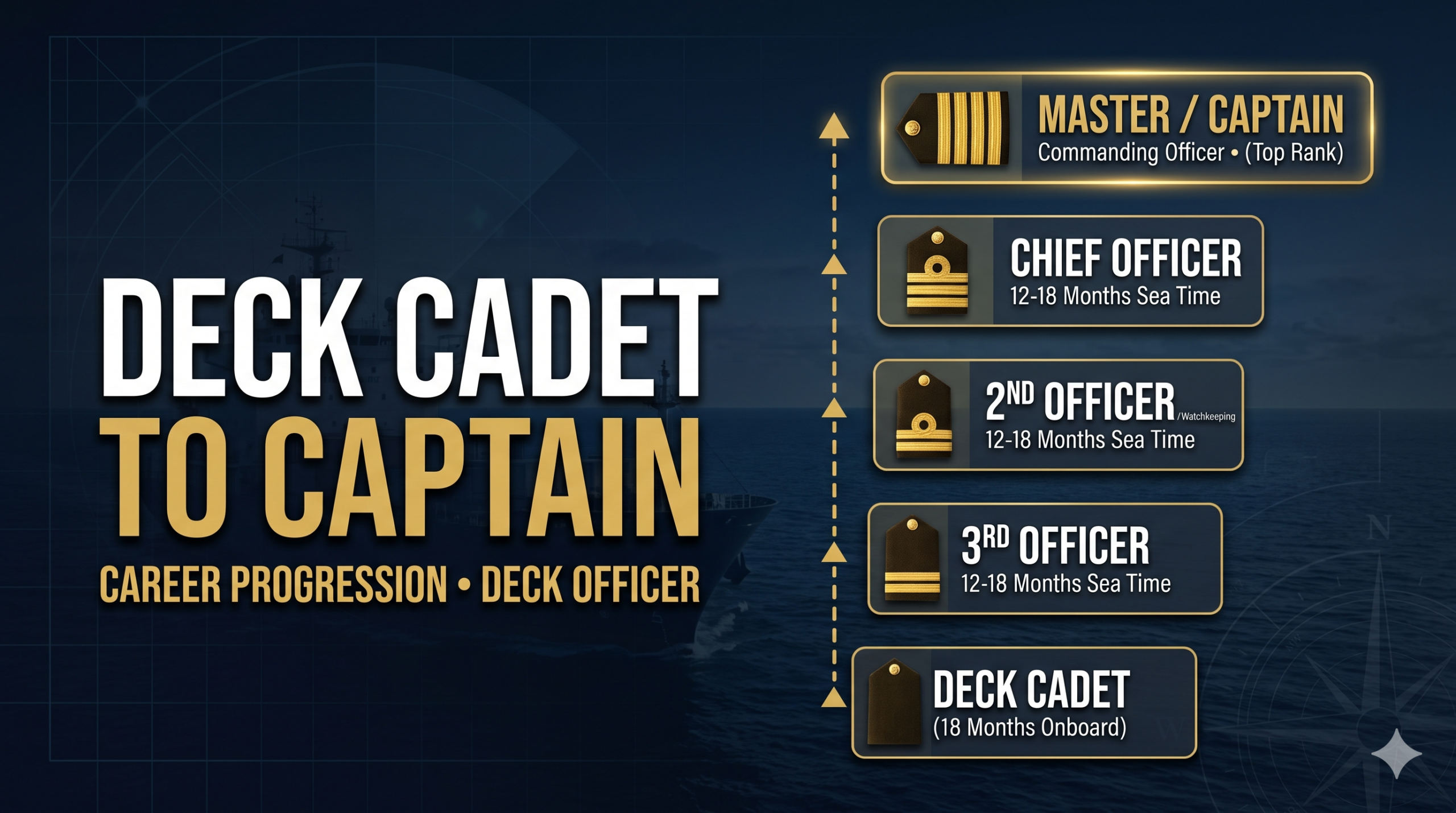
Sea time requirements are based on the DGMA nautical career guide. Verify the latest TEAP manual before applying.
Step 1: Check Your Eligibility Before Anything Else
The deck department has strict entry filters, and eyesight catches more aspirants off guard than marks do.
For DNS and B.Sc Nautical Science, DGMA lists 12th PCM with 60% aggregate, 50% in English in 10th or 12th, IMU-CET qualification, and 6/6 unaided vision with no colour blindness.
Basic eligibility checklist (officer routes):
- 10+2 with Physics, Chemistry, Maths — minimum 60% PCM aggregate
- English — minimum 50% in 10th or 12th
- Valid IMU-CET rank
- Medical fitness from a DGMA-approved doctor
- Eyesight 6/6 unaided, no colour blindness (deck)
- Unmarried status is not a regulatory requirement, but some sponsoring companies have their own policies — check each company
About the age limit — read carefully: Sources do not agree. The DGMA career page lists 17 to 21 years for DNS and 17 to 25 years for B.Sc Nautical Science. However, some IMU-affiliated institutes state a maximum age of 25 on the course start date, while others set their own lower limits, such as under 21 for boys and under 23 for girls.
The safe approach: treat the current IMU prospectus and your sponsoring company’s notice as final. Requirements may vary, and readers should verify the latest official notification before applying.
Real-world tip: Get a vision and colour test done at an approved medical examiner before paying any coaching or application fee. A failed colour vision test after admission is a painful and expensive way to find out.
Step 2: Choose Your Entry Route
There are three realistic ways onto the bridge.
| Route | Duration | Who It Suits |
|---|---|---|
| DNS | 1 yr ashore + 18 mo at sea | Fastest; needs sponsorship |
| B.Sc Nautical Science | 3 yrs ashore + 12 mo at sea | Wants full degree first |
| GP Rating | 6 mo + long upgrade path | 10th/12th pass, lower marks |
Diploma in Nautical Science (DNS)
DNS is the most popular “fast-track” route. It combines one year of pre-sea training at an IMU-affiliated institute with structured sea training as a Deck Cadet, and leads to a B.Sc (Applied Nautical Science) once all semesters and the Second Mate CoC are completed.
The big catch is sponsorship. DGMA lists mandatory company sponsorship for DNS, which means you usually clear IMU-CET and a company’s own test and interview. One leading institute notes that shipping companies prefer candidates with 70% in PCM in the first attempt, even though the official minimum is 60%.
Fees: DNS fees vary widely by institute. As one example, Tolani Maritime Institute’s 2026 prospectus lists an inclusive cost of about ₹6.78 lakh for male candidates. Always compare the full fee breakup, not just tuition.
B.Sc Nautical Science
This is a three-year undergraduate program at an IMU-affiliated institute, followed by twelve months of cadet sea time, after which you can attempt the Second Mate CoC exam. You spend longer ashore but hold a full degree, which can help if you later move to a shore job.
GP Rating → Officer (the long road)
GP Rating is for candidates who completed 10th or 12th but may not meet officer-entry criteria. After six months of pre-sea training and shipboard service, ratings can upgrade through RFPNW and Able Seafarer certificates, eventually qualify as an NCV deck officer, and with further sea time move toward foreign-going CoC exams.
It is a genuine path, but expect it to take several years longer than DNS or B.Sc.
Can a marine engineer become a captain? Not directly. Engineers progress to Chief Engineer, which is the engine-side equivalent of the Master. Moving from engine to deck would effectively mean restarting the deck certification path.
Step 3: Life as a Deck Cadet (12–18 Months at Sea)
Your cadetship is where you actually learn the job. Deck Cadets complete 12 to 18 months of structured shipboard training under the Chief Officer and Master, filling in a Training Record Book (TRB) under the Structured Shipboard Training Program (SSTP).
What this looks like onboard:
- Standing bridge watches with the officer on watch
- Helping with mooring, anchoring and cargo operations
- Maintaining life-saving and fire-fighting equipment
- Chart corrections and passage-plan practice
- Getting your TRB tasks signed off honestly — examiners will question you on them
An older DG Shipping notice on the DNS scheme also required at least six months of bridge watchkeeping duties under supervision during cadet sea time. Check whether your current SSTP specifies this.
What cadets wish they knew: Your TRB is not paperwork for the office. In Second Mate orals, examiners often pick a practical task you claimed to do and ask you to explain it step by step.

Step 4: Clear the Second Mate (FG) Exam — Your First CoC
After cadet sea time, you join a post-sea Second Mate course at an approved institute, then appear for written and oral exams.
Typical eligibility (as published by an approved institute): 12th PCM plus B.Sc Nautical Science pre-sea and 12 months SSTP sea service, or DNS pre-sea plus 18 months SSTP sea service, along with Passport, INDoS, CDC and CoC documents. The post-sea Second Mate Function course is commonly about four months.
You also complete mandatory STCW courses. DGMA lists courses such as Basic Safety Training, PSCRB, Advanced Fire Fighting, Medical First Aid, Medical Care, GMDSS (GOC), Radar/ARPA simulator, ECDIS, Bridge Resource Management and Ship Security Officer, with certificates generally valid for five years.
After passing, you receive the Second Mate CoC and usually sail as Third Officer, handling navigation watches, GMDSS, safety equipment and chart corrections.
Step 5: Build Watchkeeping Time as Third and Second Officer
This is the stage where officers grow from “watchkeeper” to “planner”. As Second Officer, you typically handle passage planning and navigational charts.
DGMA lists a minimum of 18 months of sea service as a watchkeeping officer before the Chief Mate CoC.
Important: sea time ≠ calendar time. Officers usually sail around 4–6 months and then take leave, depending on company and rank. So 18 months of sea time commonly takes 2.5–3 years in real life. This is the single biggest reason timelines on other websites look unrealistically short.
Step 6: Pass Chief Mate (FG) — Phase I and Phase II
The Chief Mate exam is the hardest academic jump in the deck career. It is conducted in two phases: Phase I covers advanced navigation, cargo and ship stability, while Phase II covers advanced seamanship and ship management.
Approved institutes run Phase I and Phase II courses of about three months each.
After the CoC, you serve as Chief Officer, the Master’s second-in-command. You run cargo operations, stability calculations, deck maintenance, crew safety and much of the ship’s Safety Management System paperwork. Many officers say the Chief Officer years are where they truly learn to command.
Step 7: Earn the Master (FG) Certificate
To appear for the Master (Foreign Going) exam, DGMA requires a minimum of 36 months of approved sea service, including at least 12 months as Chief Officer. The exam covers ship command, maritime law, commercial operations and emergency management.
DG Shipping conducts CoC exams at Mercantile Marine Department (MMD) centres in Mumbai, Chennai and Kolkata, with written papers and oral assessment at each level.
Holding a Master CoC does not automatically make you a Captain. Your company decides when to promote you. Most companies want to see strong Chief Officer appraisals, clean vetting and inspection records, and sometimes a “supernumerary” or familiarisation voyage before giving you your first command.
How Many Years Does It Take to Become a Captain?
The table below is a realistic estimate, not an official timeline. It assumes a DNS cadet with no long gaps and normal promotion.
| Phase | Approx. Calendar Time |
|---|---|
| DNS pre-sea | 1 year |
| Cadet sea time (18 months) + leave | 2–2.5 years |
| Second Mate course + exams | 6–9 months |
| Watchkeeping (18 months sea time) | 2.5–3 years |
| Chief Mate Phase I + II + exams | 6–12 months |
| Chief Officer service + Master CoC | 2–3 years |
| Total (estimate) | About 8–12 years |
A realistic picture: someone starting DNS at 18 often commands a ship somewhere between 27 and 32. Fast promotions, exam failures, recession years or long shore breaks can move this either way.

Merchant Navy Captain Salary in India (2026)
Salaries are company-specific and not fixed by the government. The figures below come from DGMA’s career guide and are indicative.
| Rank | Indicative Monthly Pay |
|---|---|
| Deck Cadet | ₹25,000–50,000 (stipend) |
| Third Officer | ₹1.2–2.0 lakh |
| Second Officer | ₹2.0–3.5 lakh |
| Chief Officer | ₹3.5–5.5 lakh |
| Master | ₹5.0–8.0 lakh+ |
| Senior Master | ₹8.0–10.0 lakh+ |
Source: DGMA indicative salary progression; it notes pay varies by company, vessel type and flag state.
You will see much higher figures online. One industry blog, for example, estimates chemical tanker Masters at around US$13,000–15,000 per month. These are industry estimates. Tankers, LNG/LPG carriers and specialised offshore vessels generally pay more than bulk carriers, but no rank or ship type guarantees a figure.
Is captain salary tax-free? It can be, depending on residency. DGMA notes that seafarers spending more than 182 days outside India in a financial year may qualify for income tax exemption. Tax rules changed with India’s new income-tax framework, so confirm your status with a qualified tax professional every year.
Skills That Get You Command (Beyond the Exams)
Exams prove knowledge. Companies promote people they trust. The traits superintendents usually look for in a Chief Officer ready for command:
- Calm decision-making in heavy weather, collisions-risk situations and medical emergencies
- Inspection readiness — PSC, flag-state and (on tankers) vetting inspections
- Commercial awareness — charter party basics, cargo claims, demurrage
- People management — multinational crews, fatigue, conflict, MLC welfare duties
- Clear communication with office, agents, pilots and charterers
- Documentation discipline — logbooks, SMS records, incident reports
Common Mistakes That Delay Becoming a Captain
- Ignoring eyesight until too late. Colour blindness disqualifies you from the deck side.
- Paying for “guaranteed placement”. No institute can guarantee a job. Check the institute on DGMA’s approved MTI list and verify any recruitment agency’s RPSL licence.
- Treating the TRB casually. Weak practical knowledge shows in orals.
- Long gaps between contracts. They stretch sea time across more calendar years.
- Letting STCW certificates expire. Renewal before joining is your responsibility.
- Rushing Chief Mate exams without stability practice. Phase I stability is where many candidates struggle.
- Hopping companies too often. Loyalty and good appraisals often speed up promotion.
What Comes After Becoming a Captain?
Command is not the end. DGMA describes Extra Master as an optional postgraduate-level qualification with a dissertation, valued for senior roles in maritime administration, classification societies and academia.
Experienced Masters also move ashore as:
- Marine superintendent or fleet manager
- Harbour pilot at major Indian ports
- Marine surveyor (class, P&I, cargo)
- Nautical surveyor with DGMA
- Faculty at maritime training institutes
- Maritime lawyer, insurance or claims specialist (with further study)
Conclusion
Becoming a Merchant Navy Captain in India is a long, structured climb, not a shortcut. Pick the right entry route (DNS for speed, B.Sc for a full degree, GP Rating if you need another way in), clear your medicals early, and treat every stage — cadet, Third Officer, Chief Officer — as training for command.
If you stay consistent with sea time and exams, most officers reach the Master’s chair within 8–12 years. Requirements may vary, so always check the latest DGMA notices, the IMU prospectus and your company’s policy before taking the next step.
13. FAQ SECTION
1. How many years does it take to become a Merchant Navy Captain?
Usually about 8–12 years after 12th. Official sea time is 36 months for the Master CoC, but leave periods, courses and exams stretch it out in calendar terms.
2. What qualification is required to become a captain in the Merchant Navy?
You need 12th PCM (60%), pre-sea training (DNS or B.Sc Nautical Science), then the Second Mate, Chief Mate and Master (FG) Certificates of Competency.
3. Can I become a Merchant Navy Captain after 12th?
Yes. After 12th PCM, clear IMU-CET and join DNS or B.Sc Nautical Science. This is the standard route to the bridge.
4. What is the age limit to join the deck side?
DGMA lists 17–21 for DNS and 17–25 for B.Sc Nautical Science, but institutes publish different limits. Check the current IMU prospectus.
5. Is colour blindness allowed for Merchant Navy Captain?
No. Deck officers need normal colour vision and 6/6 unaided eyesight as listed by DGMA.
6. How much sea time is needed for the Master (FG) exam?
DGMA lists a minimum of 36 months of approved sea service, including at least 12 months as Chief Officer.
7. Can a GP Rating become a captain?
Yes, through RFPNW, Able Seafarer, NCV officer certificates and later foreign-going CoCs. It takes longer than DNS or B.Sc.
8. Can a marine engineer become a ship captain?
Not directly. Engineers progress to Chief Engineer. Switching to deck would mean following the deck certification path.
9. What is the salary of a Merchant Navy Captain in India?
DGMA’s indicative range is ₹5–8 lakh+ per month, with senior Masters at ₹8–10 lakh+. Actual pay depends on company, vessel type and flag.
10. Is a Merchant Navy Captain’s salary tax-free?
It may be if you qualify as a non-resident (generally more than 182 days outside India in a financial year). Verify with a tax professional.
11. Who conducts the Master (FG) exam in India?
The Directorate General of Maritime Administration (formerly DG Shipping), through MMD centres in Mumbai, Chennai and Kolkata.
how to become a merchant navy captain, merchant navy captain in India, master mariner India
Master FG CoC eligibility, deck cadet to captain, merchant navy captain qualification, how many years to become captain in merchant navy, merchant navy captain salary, DNS vs B.Sc Nautical Science, Second Mate, Chief Mate, Master exam
