
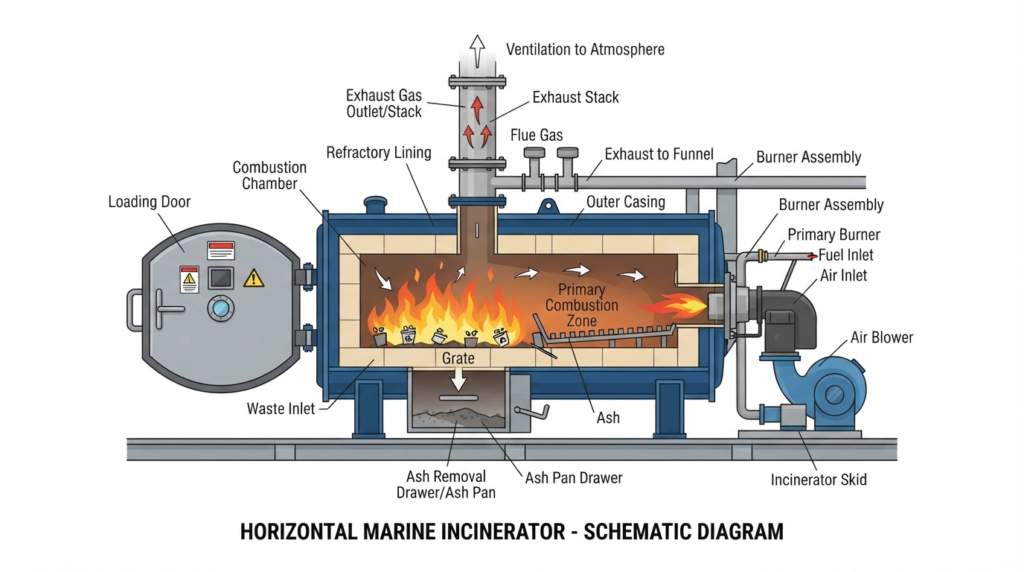
Where Does a Ship’s Waste Go? Inside the Marine Incinerator
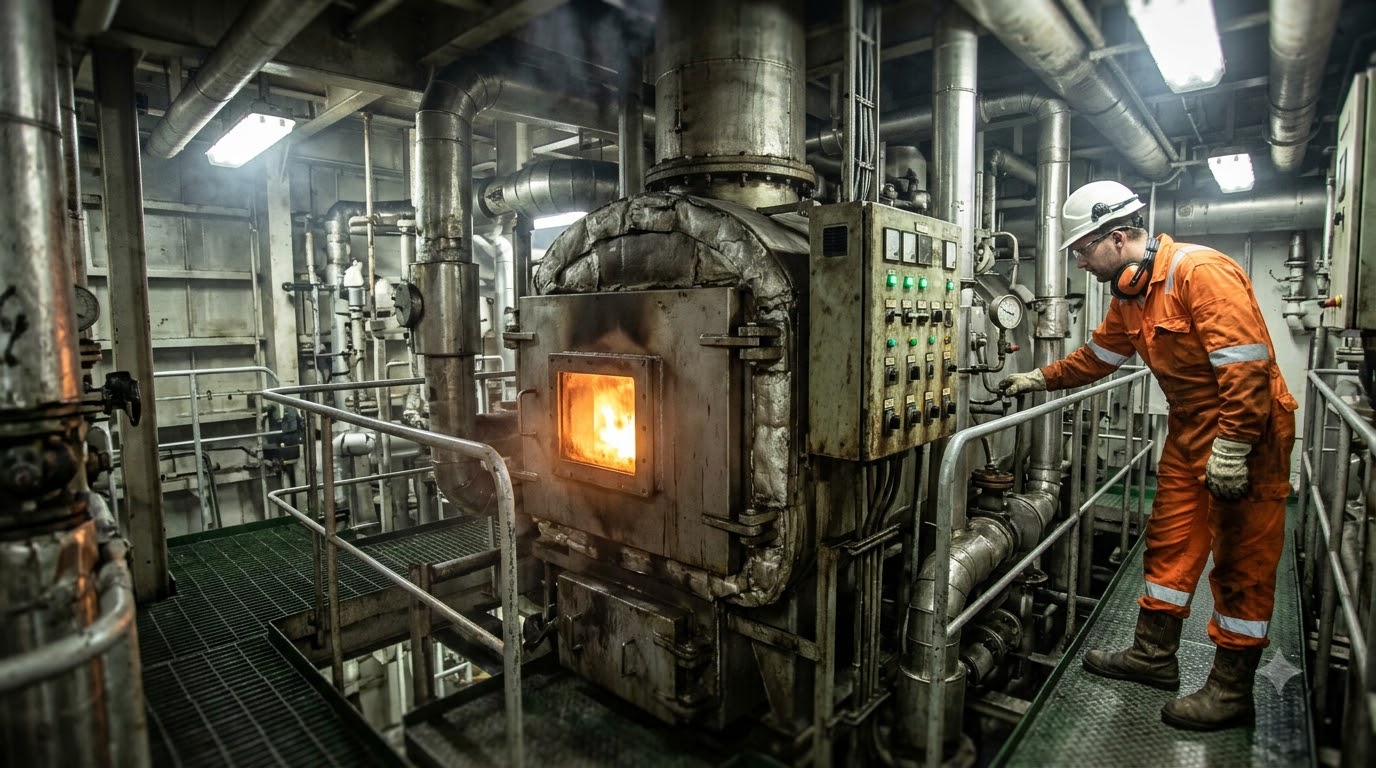
A cargo ship hundreds of miles from land still produces waste every day: purifier sludge, used lubricating oil and oily residues from the engine room, plus food waste, paper and packaging from the galley and accommodation. It cannot dump most of it overboard. A ship incinerator burns the permitted part under controlled, high-temperature conditions and leaves only ash.
This guide explains how a marine incinerator works, how ships burn sludge oil and garbage, which temperatures the IMO requires, which materials are banned, and which safety systems keep the machine under control. It is written for marine engineering students, cadets and engine-room crew.
Quick answers
- What it is: a refractory-lined combustion unit that burns permitted ship-generated waste, mainly sludge oil and solid garbage, into gases and ash.
- Minimum temperature: 850°C at the combustion chamber gas outlet. A continuous-feed unit must not be fed waste below this.
- Governing rule: MARPOL Annex VI, Regulation 16, with the 2014 technical standard in Resolution MEPC.244(66).
- Never burn: cargo residues, PCBs, garbage with more than traces of heavy metals, halogenated refined petroleum products, shore-origin sludge and exhaust gas cleaning residues.
- After burning: ash is still garbage under MARPOL Annex V and must be recorded and disposed of properly.
Written for Fleet Frontier by editor V.K. Singh. Last updated 4 November 2026. This is general educational content; the manufacturer’s manual and your flag Administration’s requirements take precedence on board.
What Is a Shipboard Incinerator and Why Do Ships Need One?
A shipboard incinerator is a combustion unit built to burn waste generated during a ship’s normal operation. It turns combustible material into gases and ash, which cuts the volume of waste stored on board.
It is commonly used for:
- Sludge oil from fuel oil and lubricating oil purification
- Waste lubricating oil, where the equipment specification allows it
- Oil residues from machinery-space oil-filtering equipment
- Food waste and galley garbage
- Paper, cardboard and certain packaging
- Approved oily rags and other permitted operational waste
Five reasons ships carry an incinerator
- Smaller waste volume. Combustion leaves far less solid waste to store.
- Machinery-space sludge disposal. Purifiers and oil-filtering equipment constantly produce oily residues, and incineration is one approved way to treat suitable sludge.
- Better garbage management. Paper, cardboard and food waste can be processed under the ship’s garbage management plan.
- Less storage needed. Tank and locker space on a ship is limited.
- Environmental protection. Correct onboard treatment, ash disposal and recordkeeping help prevent illegal discharge of garbage and oily residues at sea.
An incinerator does not make every waste safe to burn. MARPOL lists substances that are prohibited, covered later in this guide.
What Is Sludge Oil on Ships?
Sludge oil is the residual waste oil produced during normal ship operation. It comes mainly from heavy fuel oil, marine diesel oil and lubricating oil purification, from waste hydraulic and lubricating oils, and from drip trays in the machinery space.
When a centrifugal purifier cleans fuel, the separated waste can contain water, heavy fuel oil residue, carbon particles, rust, asphaltenes and other contaminants. It is collected in designated sludge tanks.
Sludge oil is not bilge water. Raw oily bilge water should not be sent to an incinerator. It is handled by separate equipment under separate pollution-prevention rules.
Types of Marine Incinerators
Designs vary by manufacturer, capacity and ship type. Two arrangements are common.
- Vertical cyclone type. The chamber stands upright with the burner near the top, and solid waste is loaded from above into a refractory-lined chamber. Some designs use a rotating arm to move waste and help remove ash and non-combustibles.
- Horizontal type. The chamber lies horizontally and waste is loaded through a charging door. The burner supplies heat, the air supply supports burning, and ash is removed only after the unit has cooled.
These are common arrangements, not a full classification of every marine incinerator.
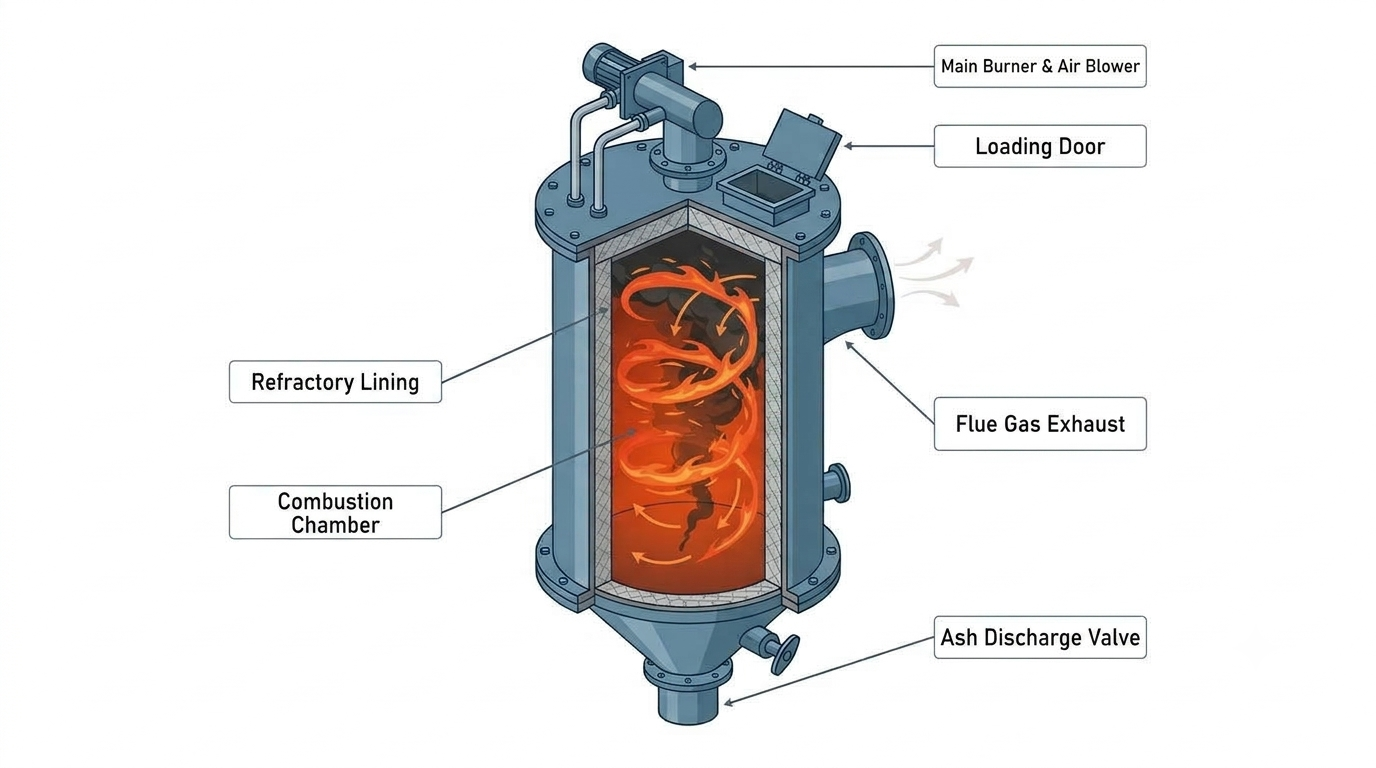
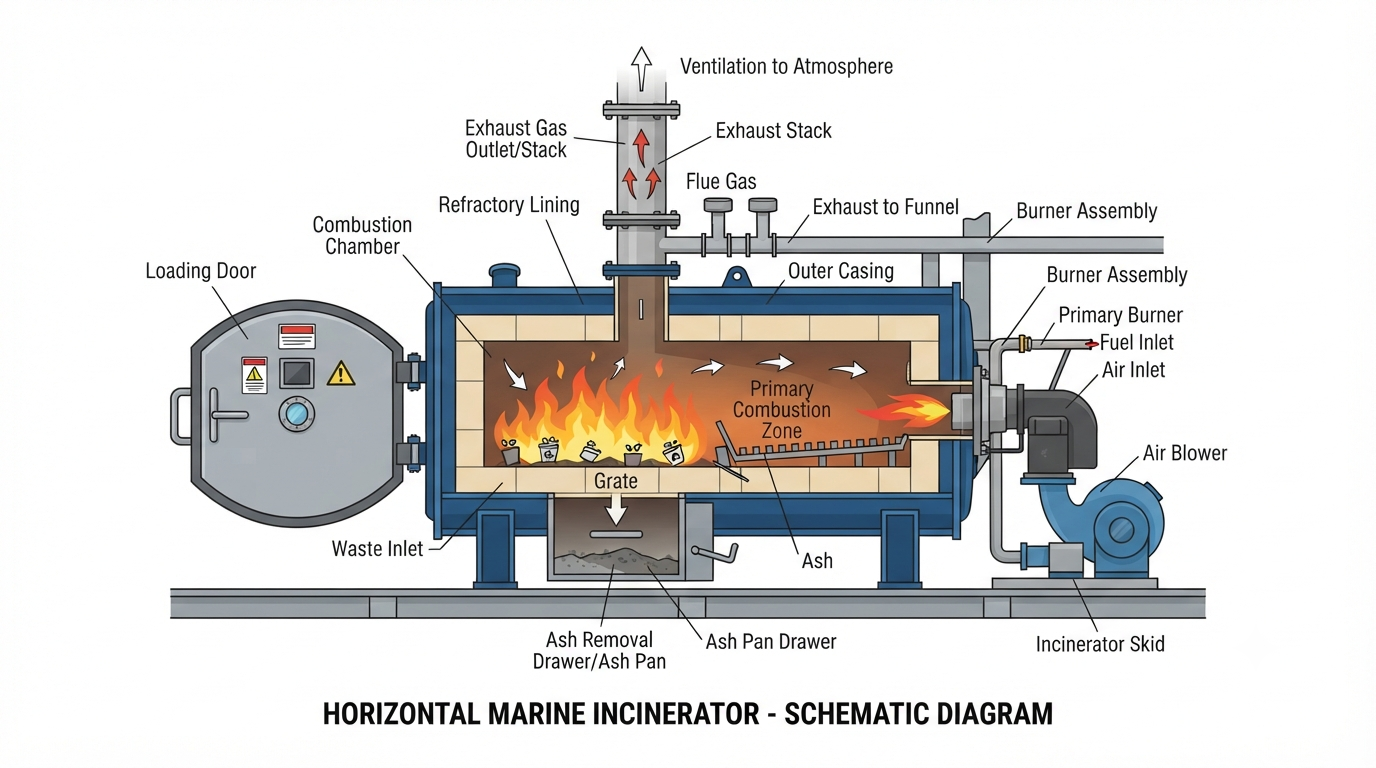
Main Components of a Ship Incinerator
| Component | What it does |
|---|---|
| Combustion chamber | Enclosed space where sludge and solid waste burn; holds the required temperature and supports air-fuel mixing |
| Refractory lining | Firebrick or castable that shields the steel casing from heat and keeps chamber temperature stable |
| Diesel oil (auxiliary) burner | Ignites waste, preheats the chamber and keeps combustion stable using marine gas oil, diesel or another approved pilot fuel |
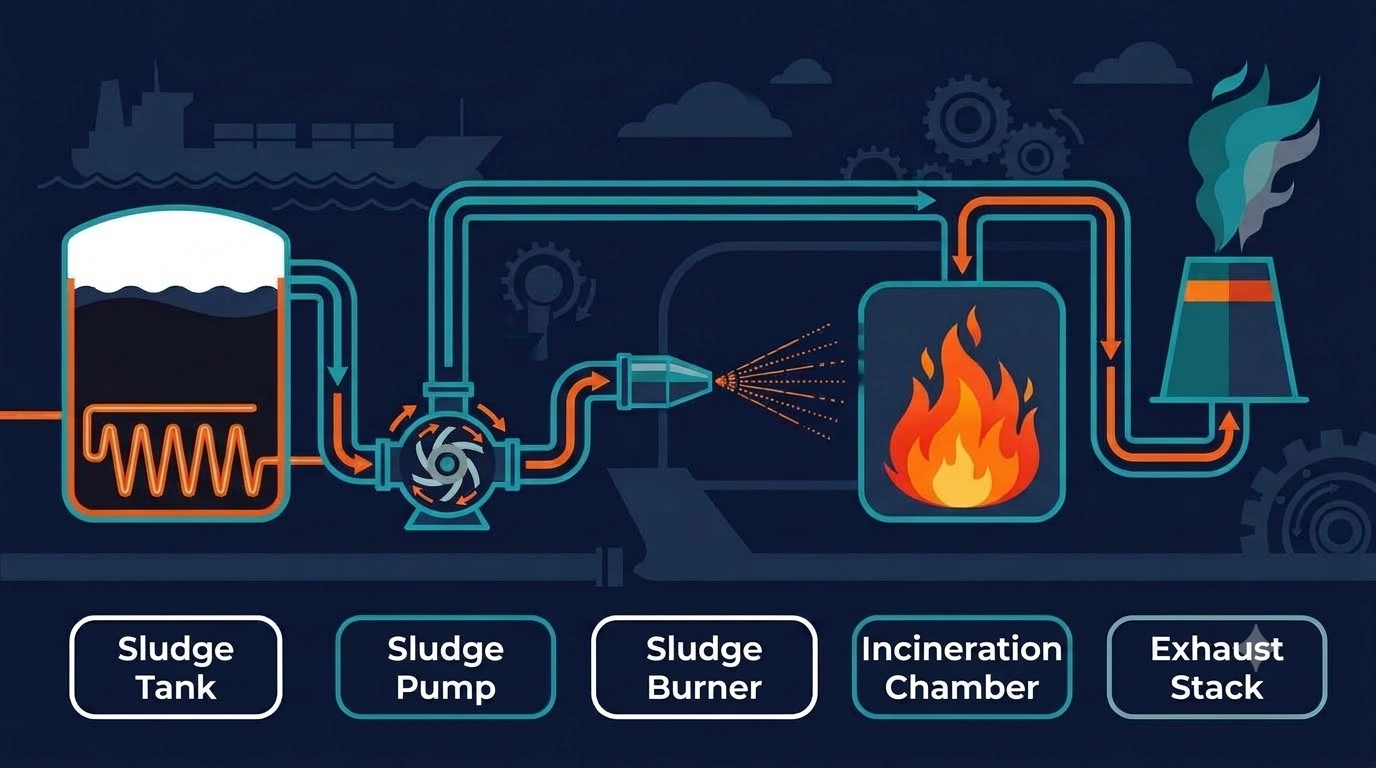
| Sludge oil burner | Atomizes liquid sludge into fine droplets so it mixes with air and burns |
| Sludge service tank | Stores sludge for supply to the burner; may have heating, circulating pump, temperature and level indication |
| Sludge settling tank | Optional tank where sludge settles before transfer to the service tank |
| Sludge circulating pump | Keeps supply to the burner consistent; needs clean filters to avoid blockage |
| Combustion air fan | Supplies oxygen, sometimes through primary and secondary air paths |
| Flue gas fan and exhaust | Removes combustion gases and keeps the chamber under negative pressure so smoke does not leak into the compartment |
| Control and safety panel | Runs the start-up sequence with temperature control, flame detection, pressure and draft monitoring, alarms, emergency stop and interlocks |
Sludge heating matters because water content, viscosity and temperature strongly affect combustion quality.
How Does a Ship Incinerator Work?
A marine incinerator works on controlled combustion: combustible waste is held at high temperature with enough oxygen that it breaks down and burns, leaving combustion gases and ash. Two waste streams are handled differently.
Sludge oil. Sludge is drawn from its designated tank and atomized by the sludge burner into fine droplets. A supporting flame and combustion air heat the droplets, which release vapours and burn. Water and solid contaminants do not burn like oil, so high water content leads to unstable combustion and smoke.
Solid garbage. Waste is loaded through a charging arrangement. Chamber heat dries it, releases gases and burns it. Ash, metals and other non-combustibles stay behind and are removed once the unit has cooled.
Step-by-Step Operating Procedure
This is a general educational outline. Always follow the manufacturer’s manual, the ship’s safety management system and applicable regulations.
- Inspect before starting. Check the chamber, refractory, ash build-up, air passages, burners, fuel and sludge lines, tank level, pumps, filters, exhaust fan, damper and safety devices. Look for leaks. Remove old ash only when the unit is isolated and cool.
- Check the waste. Confirm it is permitted under MARPOL and suitable for the unit. Never mix unknown chemicals, prohibited cargo residues or unidentified hazardous material with ordinary garbage.
- Purge. Start ventilation and combustion air. The 2014 IMO specification requires a pre-purge of at least four air changes in the chamber and stack, lasting at least 15 seconds, to clear any combustible gas.
- Start the auxiliary burner. After interlocks are satisfied, the burner runs its ignition sequence and the flame detector confirms ignition. If ignition fails, the fuel supply must shut off.
- Preheat the chamber. The standard specifies 650°C preheating for the applicable continuous-type design. A batch-loaded unit must reach 600°C within five minutes of starting and then stabilize at not less than 850°C.
- Start sludge burning. Feed sludge from the service tank as the manual directs, with the auxiliary burner supporting ignition. Excess feed, poor atomization or too much water causes unstable combustion and smoke.
- Load solid garbage. Load only approved material and stay within capacity. Overloading blocks air passages and causes incomplete burning. Never open the charging door against an interlock or while the furnace is dangerously hot.
- Monitor combustion. Watch chamber and flue gas temperature, flame, fuel pressure, sludge supply, combustion air, fan operation, negative pressure and alarms.
- Cool the flue gas. The IMO 2014 specification requires flue gas to be cooled to a maximum of 350°C within 2.5 metres of the combustion chamber outlet, which helps prevent dioxin formation.
- Shut down and remove ash. Follow the normal shutdown sequence. A post-purge of at least 15 seconds after the fuel valve closes is required. Remove ash only after cooling and when interlocks permit.
Incinerator Temperatures Under IMO Rules
Temperature is the most important operating factor. Too low, and combustion is incomplete, producing smoke and unburned material. The limits below come from MARPOL Annex VI Regulation 16.9 and Resolution MEPC.244(66).
| Parameter | IMO requirement |
|---|---|
| Minimum combustion chamber flue gas outlet temperature | 850°C |
| Maximum combustion chamber flue gas outlet temperature | 1,200°C |
| Preheating, applicable continuous-type design | 650°C |
| Batch-loaded unit, initial combustion-space temperature | 600°C within 5 minutes |
| Batch-loaded unit, subsequent stabilized temperature | Not less than 850°C |
| Minimum pre-purge | 4 air changes, at least 15 seconds |
| Minimum post-purge | 15 seconds |
| Flue gas cooling | Max 350°C within 2.5 m of chamber outlet |
Exam point: a continuous-feed incinerator must not be fed waste when the gas outlet temperature is below 850°C. A batch-loaded unit instead reaches 600°C within five minutes and then stabilizes at no less than 850°C. Do not mix the two up.
MARPOL Annex VI Regulation 16: Shipboard Incineration Rules
An incinerator is not a machine for burning everything a ship wants to discard. Regulation 16 sets the conditions.
- 16.1, equipment. Incineration must be carried out in equipment designed for it, except for the alternatives allowed under 16.4.
- 16.2, prohibited materials. Do not incinerate: residues of cargoes covered by MARPOL Annexes I, II or III and contaminated packing; polychlorinated biphenyls (PCBs); garbage with more than traces of heavy metals; refined petroleum products containing halogen compounds; sewage sludge and sludge oil not generated on board; exhaust gas cleaning system residues.
- 16.3, PVC. Burning polyvinyl chloride is prohibited except in incinerators holding the applicable IMO type approval certificate.
- 16.4, sludge in boilers. Onboard-generated sewage sludge and sludge oil may be burned in main or auxiliary power plants or boilers, but not inside ports, harbours or estuaries. This does not allow burning solid garbage in a boiler.
- 16.6, type approval. Incinerators installed on or after 1 January 2000 must comply with Annex VI and be approved by the Administration under the IMO standard specification, currently MEPC.244(66).
- 16.7, operating manual. The manufacturer’s manual, with approved operating limits, must be on board.
- 16.8, crew training. Operators must be trained to follow the manufacturer’s instructions.
- 16.9, temperature monitoring. Gas outlet temperature must be monitored whenever the incinerator operates.
What Happens to the Smoke and Exhaust Gases?
The smoke does not simply escape through the funnel. In an approved incinerator, hot gases pass through the flue gas arrangement, are rapidly cooled as the design standard requires, and leave through the approved exhaust system.
Good combustion depends on temperature, air supply, mixing and time. These are often summarized as the three Ts of combustion: temperature, turbulence and time. Performance must meet the unit’s type approval and applicable emission requirements.
Safety Systems and Interlocks
| Safety device | What it does |
|---|---|
| Flame failure protection | Shuts off fuel if the burner flame is lost; under the 2014 standard, fuel valves close within four seconds |
| Temperature controller | Shuts down the burner if temperature exceeds the manufacturer’s maximum setting |
| Negative pressure switch | Shuts down the burner and alarms if draft is insufficient, preventing gas leaks into the compartment |
| Fuel pressure protection | Triggers a safety shutdown if fuel pressure drops below the specified limit |
| Emergency stop | Located outside the incinerator compartment; stops power to the equipment and fuel pumps |
| Charging door interlock | Prevents opening while garbage is burning or when furnace temperature exceeds 220°C (for the specified arrangement) |
| Ash door interlock | Prevents opening while burning is in progress or above 220°C |
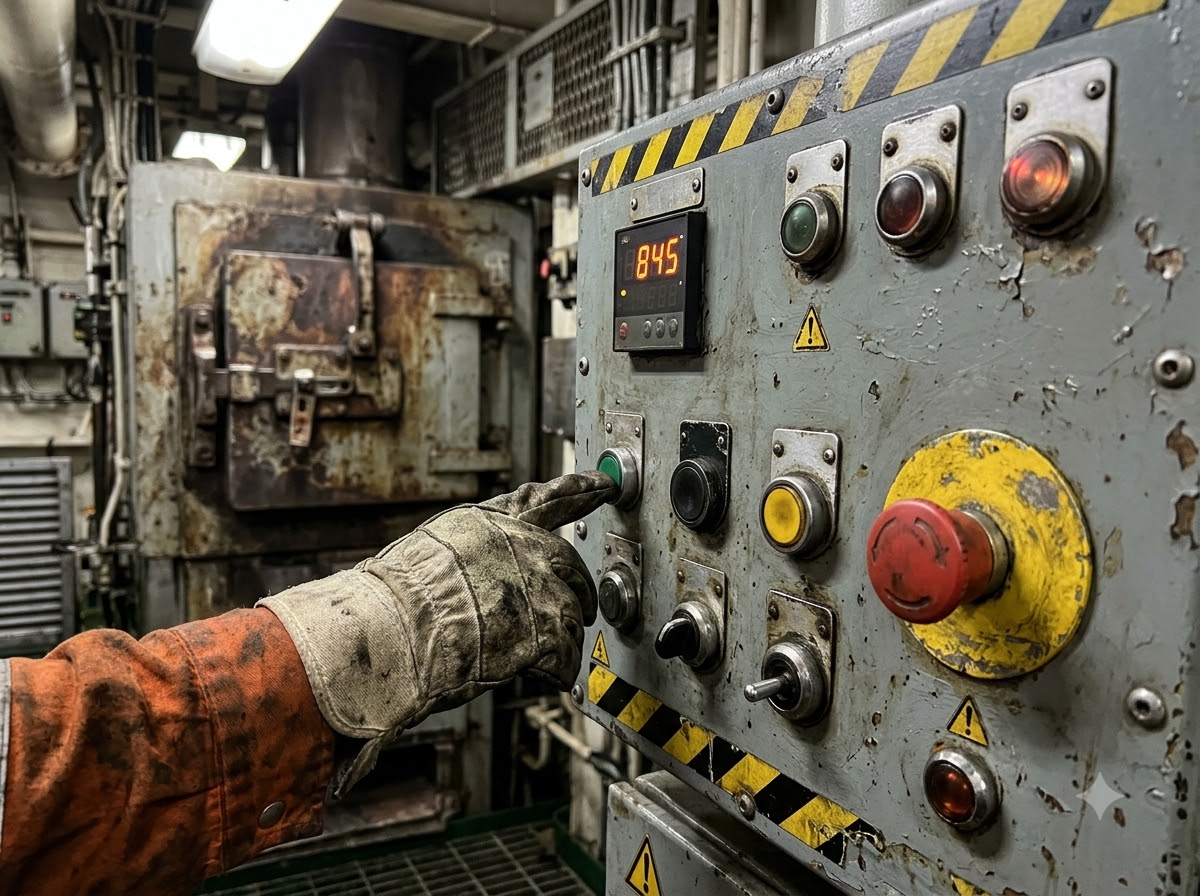
Never bypass an incinerator safety interlock to finish a job.
Common Problems and Likely Causes
| Problem | Possible causes |
|---|---|
| Black smoke from the funnel | Insufficient air, poor atomization, overfeeding or incomplete combustion |
| Low combustion temperature | Excess moisture, unsuitable waste, poor fuel supply or damaged refractory |
| Unstable sludge flame | Clogged burner nozzle, wrong sludge viscosity or fluctuating fuel pressure |
| Burner fails to ignite | Ignition electrode fault, pilot fuel problem or faulty flame detector |
| Excessive ash | Overloading, unsuitable waste or poor combustion |
| Frequent trips | Flame failure, low fuel pressure, draft failure or temperature-control problems |
| Smoke leaking from the door | Loss of negative pressure, damaged door seal or exhaust fan problems |
| Poor combustion | Wrong air-fuel ratio, unsuitable waste or inadequate temperature |
Do not assume every black-smoke problem is a lack of air. Check waste quality, fuel supply, burner condition, temperature and draft together, and follow the manufacturer’s troubleshooting steps.
Maintenance Checklist
- Combustion chamber: inspect refractory for cracks and damaged insulation; remove ash and slag once cool.
- Burner system: inspect and clean the nozzle as instructed; check ignition electrodes, flame detector and supply lines.
- Sludge system: inspect pumps, clean filters and strainers, check tank heaters, valves and pipes for leaks.
- Air and exhaust: check air openings, fans, dampers and exhaust passages; verify negative pressure.
- Electrical and controls: check temperature sensors, alarms and safety switches; test emergency shutdown, flame failure protection and interlocks.
Intervals follow the manufacturer’s schedule and the ship’s planned maintenance system.
Garbage Record Book: What Must Be Recorded?
Under MARPOL Annex V, completed incineration must be entered in the Garbage Record Book. Record the date and time, the ship’s position at the start and stop of incineration, the categories of garbage burned, the estimated quantity, and the signature of the responsible officer.
Incinerator ash is still garbage under Annex V. It cannot simply be thrown overboard; storage and final disposal must follow the garbage discharge requirements and port reception arrangements.
Advantages and Limitations
| Advantages | Limitations |
|---|---|
| Reduces the volume of combustible garbage | Needs fuel and electrical power |
| Helps manage machinery-space waste oil residues | Needs regular inspection and maintenance |
| Reduces long-term waste storage | Can produce harmful emissions if run incorrectly |
| Supports the ship’s waste management system | Cannot legally or safely burn every waste |
| Converts suitable waste into ash | Needs trained operators; ash still needs disposal |
Ship Incinerator vs Ship Boiler
| Shipboard incinerator | Ship’s boiler |
|---|---|
| Designed for waste treatment | Designed to generate steam |
| Burns permitted garbage and sludge | Normally burns suitable fuel oil |
| Produces gases and ash | Transfers heat to water to make steam |
| Main purpose is waste reduction | Main purpose is steam production |
| Governed by MARPOL Annex VI Regulation 16 and applicable standards | Governed by machinery, safety and pollution requirements |
Regulation 16.4 lets a ship burn onboard-generated sewage sludge and sludge oil in main or auxiliary power plants or boilers, except in ports, harbours and estuaries.
Frequently Asked Questions
What is a shipboard incinerator? A specially designed machine that burns suitable waste generated during normal ship operation.
Which MARPOL regulation covers shipboard incineration? MARPOL Annex VI, Regulation 16.
Which IMO resolution sets the 2014 standard for shipboard incinerators? Resolution MEPC.244(66).
What is sludge oil on a ship? Residual waste oil from normal operation, such as waste from fuel and lubricating oil purification.
Why does an incinerator have a diesel oil burner? It provides the initial ignition and heat needed to start and support combustion.
Why is refractory lining used? It protects the casing from excessive heat and keeps the chamber at the required temperature.
What is the minimum temperature for a continuous-feed incinerator? 850°C at the combustion chamber gas outlet. Waste must not be fed below it.
What temperature must a batch-loaded incinerator reach? 600°C within five minutes of starting, then stabilize at not less than 850°C.
Why is negative pressure maintained in the chamber? To stop smoke and combustion gases leaking into the surrounding space.
What does a flame failure detector do? It detects loss of the burner flame and triggers fuel shut-off to prevent unsafe fuel accumulation.
Can PVC be burned in a ship incinerator? Only in an incinerator holding the applicable IMO type approval certificate.
Can sludge oil be burned in a ship’s boiler? Onboard-generated sludge oil can be burned in main or auxiliary power plants or boilers, but not inside ports, harbours or estuaries.
Why is sludge heated before burning? Heating lowers viscosity, making it easier to pump and atomize.
What does the flue gas fan do? It maintains draft and negative pressure and helps remove combustion gases.
What happens to the ash? It is collected, stored and disposed of under MARPOL Annex V and the ship’s garbage management procedures.
Conclusion
A shipboard incinerator helps a ship manage waste responsibly, but running one safely takes more than lighting a burner and loading waste. Engineers need to understand sludge preparation, atomization, temperature, air supply, negative pressure, flue gas cooling, safety interlocks and, above all, which materials are permitted and which are banned. Used correctly, it is a clear example of machinery, safety and environmental protection working together at sea.
Sources
- IMO: Shipboard Incineration, MARPOL Annex VI Regulation 16
- IMO Resolution MEPC.244(66): 2014 Standard Specification for Shipboard Incinerators
- IMO: Prevention of Pollution by Garbage from Ships, MARPOL Annex V
- SEAFDEC: Incinerator On Board M.V. SEAFDEC
- MARPOL Consolidated Edition, Annex VI Regulation 1
ship incinerator, marine incinerator, shipboard incinerator working principle, sludge oil on ships, MARPOL Annex VI Regulation 16, MEPC.244(66), incinerator temperature IMO, ship garbage disposal

