

Ship Bunkering Explained: Procedure, Safety Checks, Types and Regulations (2026 Guide)
By V.K. Singh · Fleet Frontier · Last Updated: October 2026


Ship bunkering is the process of supplying fuel to a ship for its own use — for main engines, generators and boilers. If you are a marine engineering student, an engine cadet or a junior engineer, bunkering is something you will see within your first few months at sea, and something you will be asked about in almost every oral exam.
This guide explains the complete ship bunkering procedure in plain English: the planning, the checks before, during and after transfer, who does what onboard, how samples and the Bunker Delivery Note (BDN) work, the types of bunkering, and the MARPOL Annex VI and DG Shipping rules that apply in 2026.
Note: The step-by-step checks below reflect widely used shipboard practice and typical company Safety Management System (SMS) procedures. Exact limits and forms vary by company and vessel. Always follow your own ship’s SMS and the latest official notifications.
Quick Answer: What Is Ship Bunkering?
Ship bunkering is the transfer of marine fuel (such as VLSFO, HSFO, MGO, LNG or methanol) from a bunker barge, shore terminal or tanker truck into a ship’s fuel tanks. The Chief Engineer is the person in charge. A safe bunkering operation follows a written plan, pre-transfer checks, continuous supervision, controlled topping-off, sampling and proper documentation.
Why Bunkering Matters So Much Onboard
Fuel is usually the single biggest operating cost of a ship, so every tonne counts. But bunkering is also where a lot can go wrong in a very short time:
- Oil pollution: An overflowing tank vent can put oil on deck and into the sea within minutes.
- Quantity disputes: A few tonnes “missing” can mean thousands of dollars lost.
- Fuel quality problems: Off-spec fuel can damage fuel pumps, injectors and purifiers, or even cause a blackout.
- Legal exposure: Wrong sulphur content or missing paperwork can lead to Port State Control (PSC) detention and fines.
That is why most companies treat bunkering as a “critical operation” with its own checklists, training and sign-offs by the Master and Chief Engineer.
Types of Bunkering
By delivery method
| Method | How it works | Where you see it |
|---|---|---|
| Barge-to-ship (ship-to-ship) | Bunker barge comes alongside and pumps fuel through a hose | Most common at anchorages (Singapore, Fujairah, Mumbai, Kandla) |
| Shore-to-ship (terminal/pipeline) | Fuel supplied from a shore tank via pipeline at a berth | Oil jetties, refinery terminals |
| Truck-to-ship | Road tanker supplies small quantities | Small ports, small vessels, LNG pilots |
| Ship-to-ship for alternative fuels | Specialised vessels supply LNG or methanol | Growing at major hubs |
By fuel type
| Fuel | Typical use / note |
|---|---|
| VLSFO (≤0.50% sulphur) | Most common main fuel since IMO 2020 |
| HSFO (high sulphur) | Only for ships with an approved scrubber (EGCS) |
| ULSFO / MGO / MDO (≤0.10%) | Used inside Emission Control Areas and at EU berths |
| LNG | Dual-fuel ships; needs cryogenic handling |
| Methanol | Emerging alternative fuel; India has begun trials |
| Biofuel blends | B24/B30 blends used by some operators |
Who Does What: Bunkering Responsibilities Onboard
Bunkering is a team job. A typical shipboard SMS assigns duties like this:
| Person | Main responsibilities |
|---|---|
| Chief Engineer | Person in Charge (PIC); prepares the bunker plan; conducts training; holds pre-transfer conference with the barge PIC; checks the BDN against ordered specs; signs the bunker receipt |
| Master | Approves the plan; ensures stability and that ballast operations do not interfere |
| Chief Officer | Keeps trim, list and stresses within limits; arranges access ladder; ensures scuppers are plugged, “No Smoking” notices posted and SOPEP locker ready |
| Duty Engineer | Lines up valves, changes over tanks, takes initial, periodic and final soundings |
| Fitter | “Point of Transfer” watch — stays at the manifold throughout |
| Motorman | Assists with soundings and other tasks as instructed |
| Duty AB | “Deck Rover” — watches vents, sounding pipes and the water around the ship for any oil |
A rule you will hear from every Chief Engineer: people assigned to bunkering do not do anything else during the operation, and the operation is never left unattended. The engine room must be manned throughout, and relief personnel should be arranged so no one breaks STCW hours of rest.
Stage 1: Bunker Planning
Good bunkering starts days before the barge arrives.
Safe filling limits
A common company standard is:
- Maximum 90% of tank volume for each bunker tank
- Maximum 85% for the finishing tank (the last tank filled), because line draining and air blowing at the end push extra oil into it — some companies allow 90% if the tank is larger than about 1,000 m³
Some companies allow up to 95% only with a risk assessment, overflow tanks fitted with high-level alarms, and office approval. These figures are company practice, not a single statutory number, so always check your SMS.
Avoiding commingling
Fuel from different ports or suppliers can be incompatible. When mixed, it may form heavy sludge in purifiers and filters or separate into layers (stratification). Good practice:
- Consolidate remaining fuel into as few tanks as possible before bunkering
- Load new fuel into empty tanks
- If mixing is unavoidable, avoid a 50:50 ratio — a large quantity of one fuel with a small quantity of another is less risky
- An onboard spot test (mix 50/50, heat, drop onto blotting paper) can give a quick indication: a uniform stain suggests compatibility; two distinct rings suggest trouble
Keep enough old fuel
Plan so the ship does not need to burn the new fuel until the lab analysis report arrives. If the report is late, the Chief Engineer should consult the technical superintendent rather than switch fuels on their own.
The bunker plan
The written plan, signed by the Master and Chief Engineer, typically includes:
- Name of barge or terminal and quantity/grade ordered
- Tanks to be filled and the filling sequence
- Starting soundings and estimated final soundings/ullages
- Starting rate, maximum rate, topping-off rate and max line pressure
- Communication method and emergency stop signals
- Diagram of bunker lines and tanks
- Named personnel, relief arrangements and contingency plans
Training before bunkering
Many companies require a briefing within 48 hours before bunkering, covering each person’s role, the plan, hand signals, emergency shutdown and the “repeat back” rule for orders. It is recorded in the log book.
Stage 2: Pre-Transfer Checks (Before Bunkering)
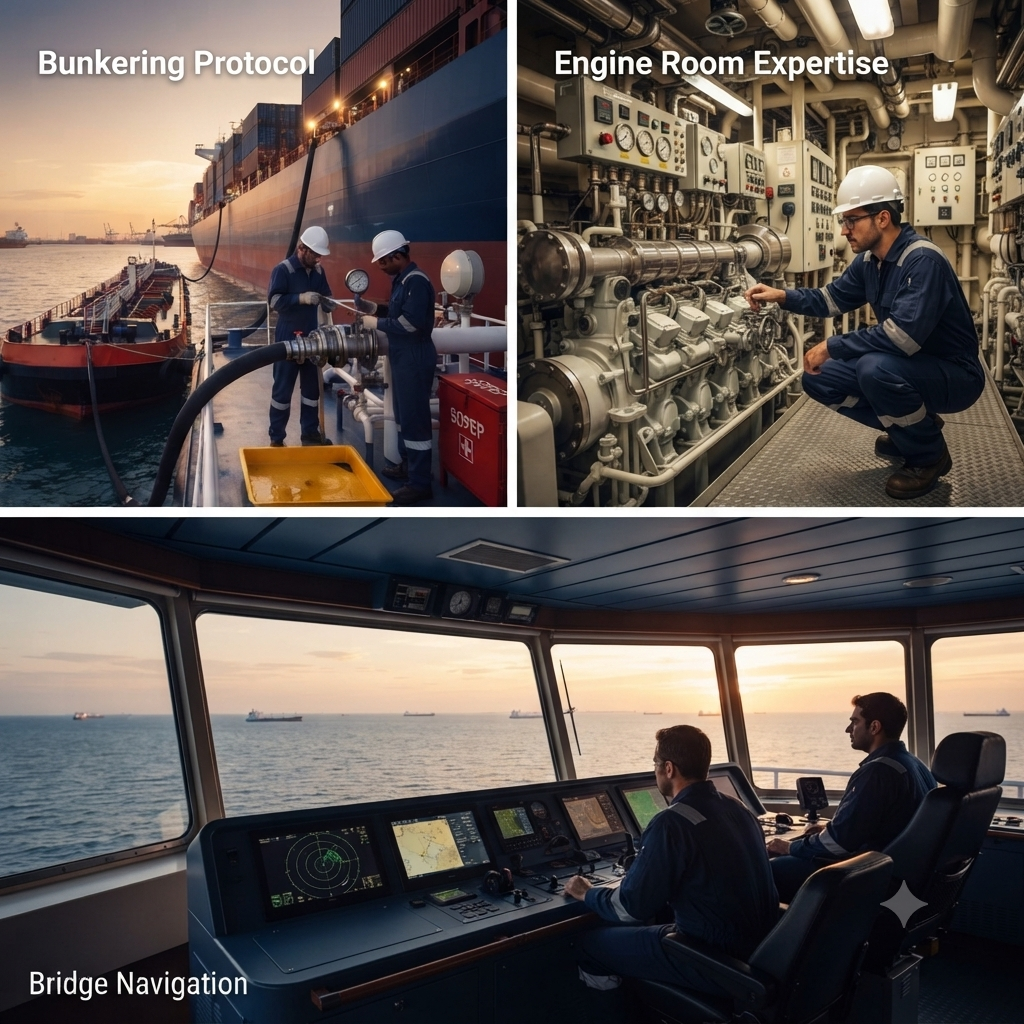
These are the checks you will find on almost every pre-bunkering checklist:
Deck and pollution prevention
- All deck scuppers plugged and tested for tightness
- Drip trays/save-alls in place under the manifold and vents, drained of water and plugged
- Unused manifold connections blanked with all bolts fitted
- Tank vents clear, marked, and flame screens intact
- SOPEP spill kit, absorbents and sawdust ready near the manifold
- Manifold area well lit; “No Smoking / No Naked Light” signs posted
- Blank flange ready for when the hose is disconnected
Equipment
8. Bunker hoses inspected and suitable for the service; hose weight within SWL of the crane/derrick; no sharp bends
9. Pressure gauges fitted and working
10. High-level alarms tested; remote gauges checked against manual soundings
11. Sounding pipe self-closing cocks working — never tied open
12. All valves correctly lined up; valves not in use closed (and lashed if required)
Coordination
13. Weather and bunkering area accepted by both vessels; port authority informed
14. Mooring plan agreed; barge has adequate fenders
15. VHF/UHF channel tested and a backup channel agreed
16. Initial soundings of ship and barge tanks taken; quantity agreed
17. Starting rate, maximum rate and topping-off rate agreed
18. Emergency stop procedure agreed; barge person at the emergency stop identified
The pre-transfer conference
The Chief Engineer meets the barge PIC to confirm grade and quantity, rates, signals and emergency shutdown, and to identify the Point of Transfer and Deck Rover watches. Both sign the checklist.
Real-world tip: Before the barge even connects, walk around the ship and look at the water. If there is already oil on the surface, note it with time and photos. Otherwise, you may be blamed for someone else’s spill.
Stage 3: Starting the Transfer
- Start at a slow rate as agreed.
- Keep an engineer at the manifold while the line is pressurised — this is when weak gaskets or hose connections leak.
- Immediately confirm that oil is entering the correct tank by sounding it.
- Only when everything is confirmed, signal the barge to increase to the agreed rate.
- If any leak or fault appears: stop first, investigate later.
Stage 4: During Bunkering
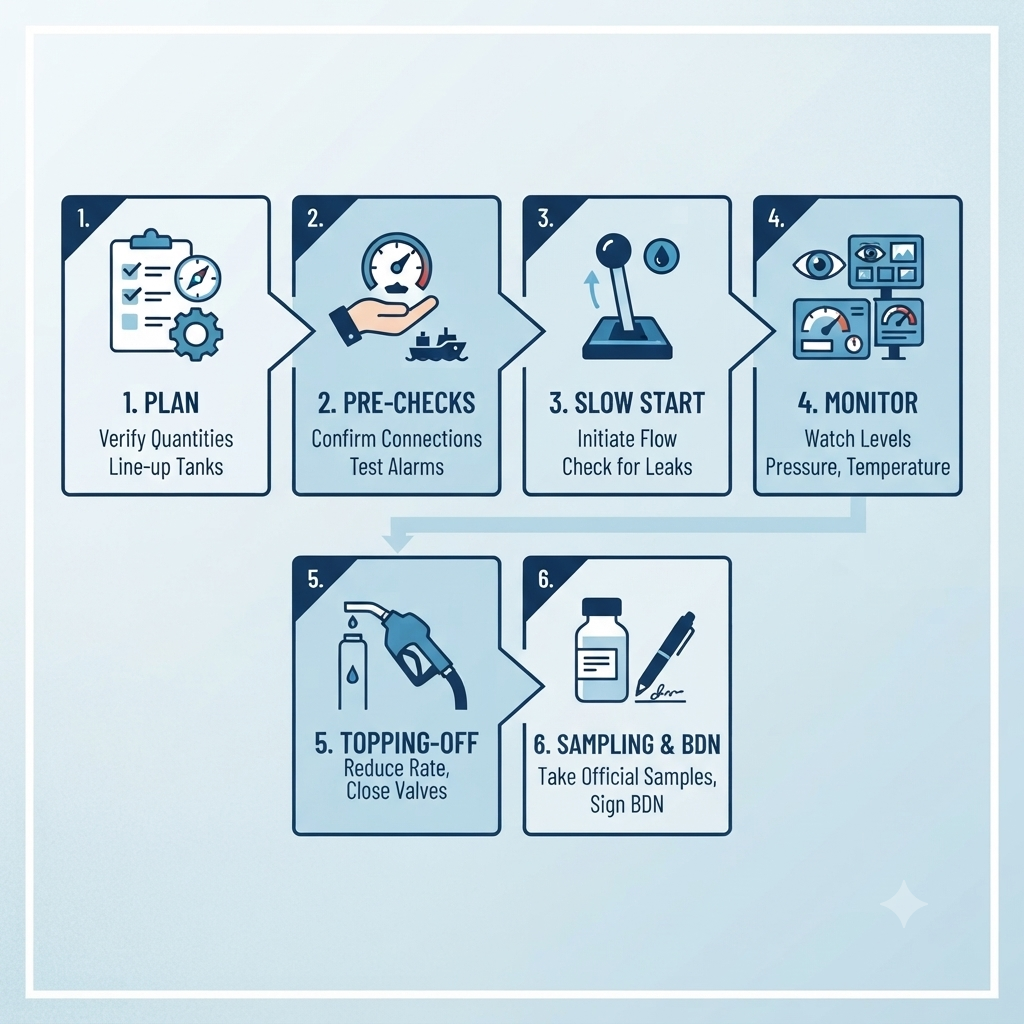
| What to watch | Why |
|---|---|
| Regular manual soundings (more often near full) | Remote gauges can fail; manual sounding is the final check |
| Tanks not being filled | A rising level means a leaking or wrongly open valve |
| Hose, manifold and drip trays | Early leak detection |
| Vents and overflow tank | First sign of an overfill |
| Trim and list | Changing list affects soundings and can cause overflow; report to the Chief Officer |
| Manifold pressure | A sudden rise can mean a closed valve |
| Pumping rate calculation | Gives estimated time to change over and complete |
| Fuel temperature | Higher-than-declared temperature affects volume correction and can hide a shortfall |
| Continuous drip sample | Must run throughout the delivery |
Key operating rules
- Fill one tank at a time where possible. Watching several tanks at once multiplies overflow risk.
- Open the next tank valve before closing the current one. Closing first can cause a pressure surge and burst a hose or gasket.
- Inform the barge before changing tanks if a pressure rise is likely.
- If the expected completion time is exceeded, stop and find out why — oil may be going somewhere you did not plan.
Stage 5: Topping-Off — The Most Dangerous Phase
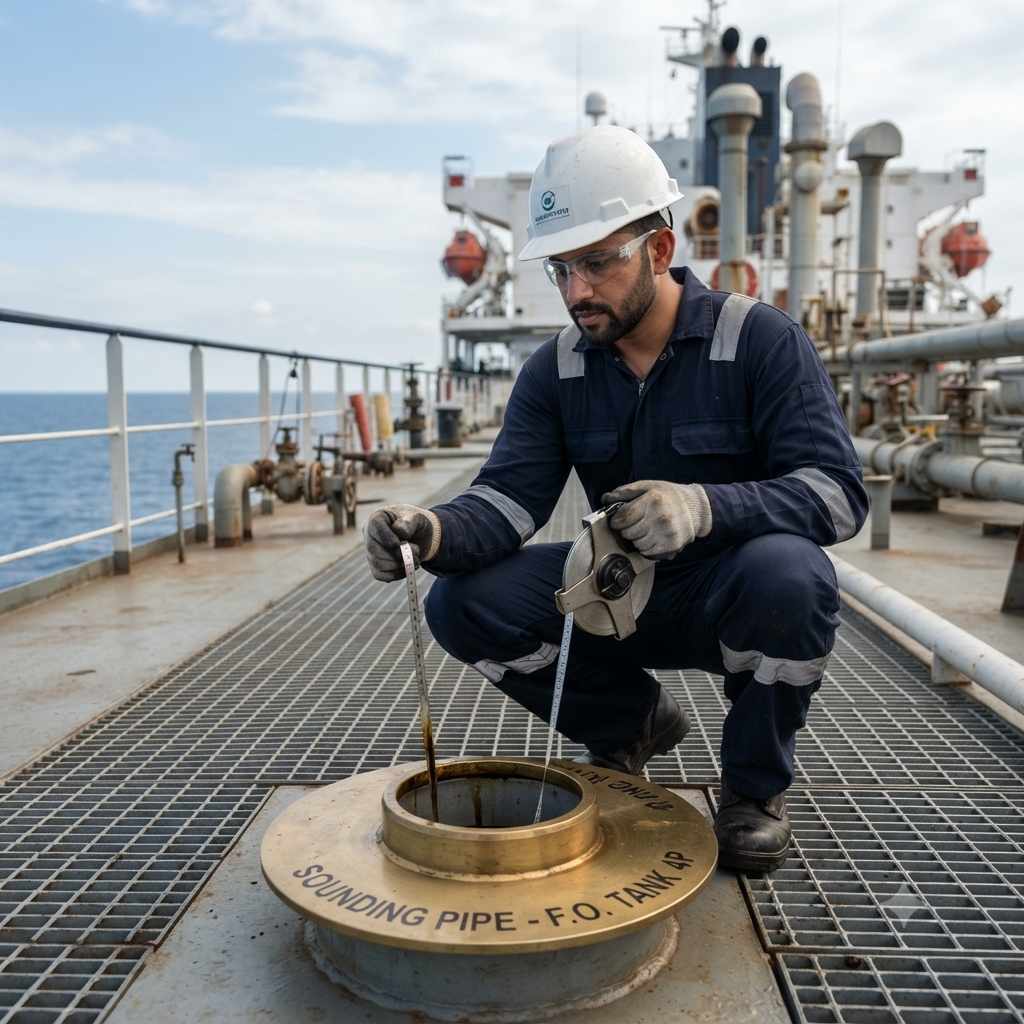
Most bunker spills happen when tanks are nearly full. Typical precautions:
- Alert the Chief Engineer about 30 minutes before expected completion
- Alert the barge about 10 minutes before completion
- Reduce the pumping rate (many companies do this once the finishing tank passes about 80%)
- Do not exceed the safe maximum for the finishing tank
- No air blowing of the hose by the barge without informing the ship; take soundings and close sounding pipe caps first
- Stop the operation if there is any doubt
Stage 6: After Bunkering
- Record final soundings, corrected for trim, list and temperature (volume converted to standard 15°C and then to mass using density)
- Compare the received quantity with the barge figures and the BDN
- Drain the hose, close all bunker valves, blank the hose before returning it
- Seal and label samples; sign sample labels with the barge representative
- Sign the bunker receipt/BDN — the Chief Engineer signs for the quantity actually received
- Make entries in the Oil Record Book Part I (bunkering is recorded under Code H), engine log and fuel log
- Send the analysis sample to the laboratory
- Remove any spilled oil completely before reopening scuppers
- Do not use the new fuel until the lab report confirms it is on-spec
What if there is a shortfall?
If the ship’s figures are lower than the barge’s figures, the Chief Engineer can issue a Letter (Note) of Protest to the barge or supplier before signing — and should sign the BDN only for the quantity verified, or endorse it “signed for receipt only, quantity disputed” as per company instructions. Common reasons for disputes include temperature manipulation, entrained air (“cappuccino bunkers”) and incorrect barge soundings.
Bunker Sampling: How Many Samples and Why
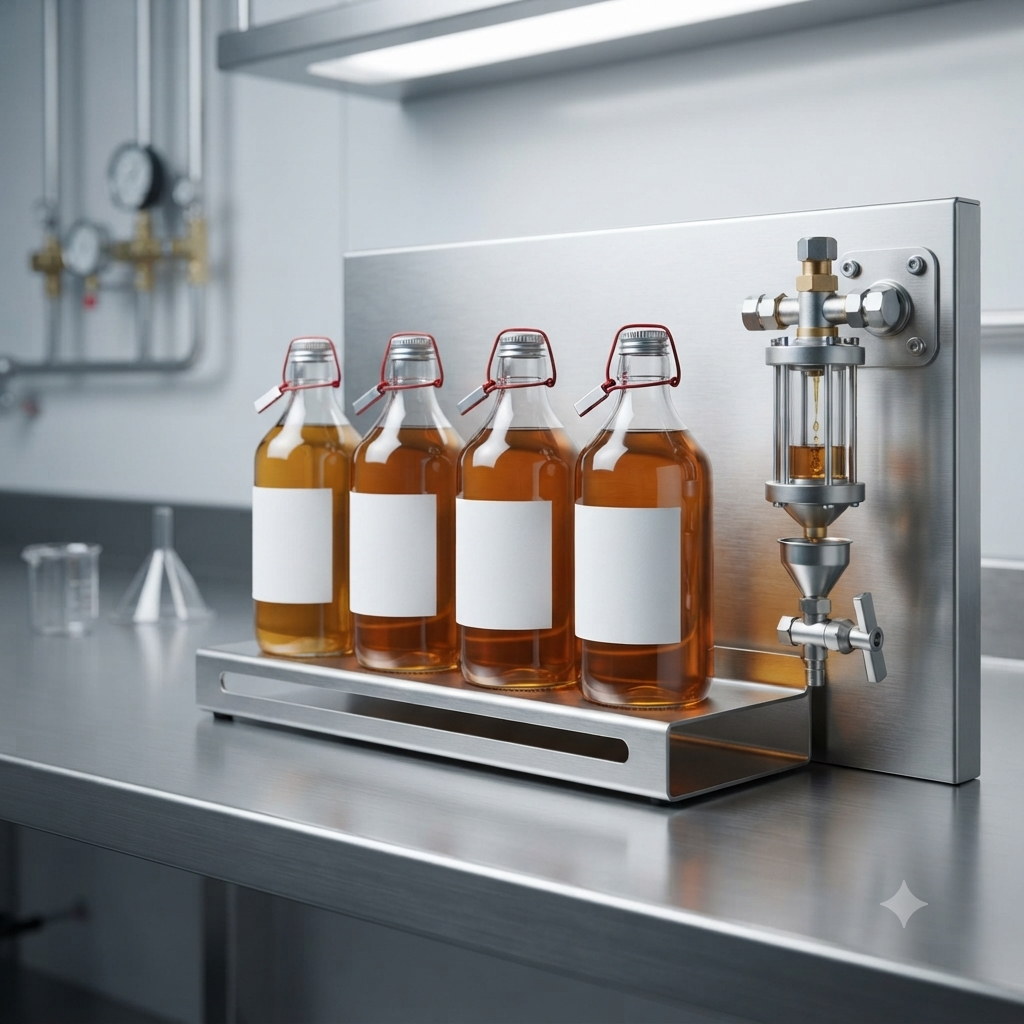
Most ships draw a continuous drip sample at the ship’s manifold throughout delivery, then split it into several sealed bottles. A typical distribution is:
| Sample | Kept by / used for |
|---|---|
| MARPOL (retained) sample | Kept onboard for regulatory verification |
| Ship’s sample | Kept onboard for commercial disputes |
| Supplier/barge sample | Given to the barge |
| Lab analysis sample | Sent to a fuel testing laboratory |
The MARPOL delivered sample is the legal one. It is used to verify the sulphur content of fuel delivered to the vessel at the point of custody transfer, and is generally collected following IMO guidelines MEPC.182(59). MARPOL Annex VI also refers to in-use and onboard samples, which PSC can use to check the sulphur content of fuel in use or stored in bunker tanks.
Retention rule: The MARPOL representative sample must be kept until the fuel is substantially consumed, and in any case for at least 12 months from delivery.
The Bunker Delivery Note (BDN)
The BDN is the supplier’s official record of what was delivered. Under MARPOL Annex VI Regulation 18, it must include the receiving ship’s name and IMO number, port, date of delivery start, supplier details, product name, quantity in metric tonnes, density at 15°C, sulphur content, and a signed declaration of conformity.
- Retention: The BDN must be kept onboard where it is readily available for inspection and retained for three years after delivery.
- Electronic BDNs: An electronic BDN is acceptable, but must likewise be kept for at least three years and be readily available for inspection.
Before signing: check grade, density, sulphur, viscosity (where listed) and quantity against what was ordered and against the ship’s own figures.
Regulations That Govern Bunkering
MARPOL Annex VI (air pollution)
- Global sulphur cap: 0.50% m/m outside Emission Control Areas (in force since 1 January 2020), unless an approved scrubber is used.
- ECAs: 0.10% m/m sulphur limit. From 1 May 2025, ships in the Mediterranean Sea ECA may not use fuel above 0.10% sulphur unless they use an approved equivalent such as a scrubber. The Canadian Arctic and Norwegian Sea become SOx ECAs from 1 March 2027.
- Regulation 18: fuel quality, BDN and sampling requirements.
Ships must also plan fuel changeover before entering an ECA — another reason careful bunker segregation matters.
MARPOL Annex I (oil pollution)
- Oil Record Book Part I entries for bunkering
- SOPEP (or SMPEP) for spill response
SOLAS and ISM Code
- Fuel flashpoint limits (generally not below 60°C for most ships’ fuel)
- Company SMS procedures, checklists and drills for bunkering
STCW
- Hours of rest — the reason relief crew must be planned for long bunkering operations
Industry standards
- ISO 8217 — specification of marine fuels (what “on-spec” means)
- ISO 13739 — procedures for the transfer of bunkers to vessels
- Port-specific rules (for example, Singapore requires mass flow meters on bunker barges)
Bunkering Rules in India (DG Shipping)
India is a party to MARPOL Annex VI, and DG Shipping regulates bunker suppliers.
- Supplier registration: Merchant Shipping Notice 03 of 2014 covers registration of bunker suppliers, and makes the supplier responsible for providing the BDN and meeting regulations 14 and 18 of Annex VI. dgshipping
- Electronic BDN via Swachh Sagar: Under DGS Circular 04 of 2023, all registered and licensed bunker suppliers must use the Swachh Sagar portal to enter bunker supply data, generate an electronic BDN and issue it to the receiving ship.
- Consolidated Annex VI notice: DG Shipping’s Merchant Shipping Notice No. 16 of 2023 (dated 14 November 2023) consolidates all its orders, notices and circulars on MARPOL Annex VI implementation. dgshipping
India’s alternative-fuel bunkering push (2026)
India is starting to build green bunkering capacity. On April 2, 2026, Kandla Port conducted a trial shore-to-ship methanol bunkering operation, and plans ship-to-ship methanol bunkering in the next phase. The Shipping Minister also told Parliament that V.O. Chidambaranar Port is developing a green methanol bunkering facility with a total capacity of 1,500 m³.
For students, this means future bunkering knowledge will include methanol and LNG handling, not just conventional fuel oil.
Requirements may vary and readers should verify the latest DG Shipping notification before relying on any specific rule.
Internal Oil Transfers: Same Risks, Same Discipline
Transfers between your own tanks (for example, storage to settling tank, or sludge transfers) can overflow just as easily. Common company rules:
- Same overflow precautions as bunkering
- Avoid transfers during darkness unless unavoidable — if done, a senior engineer attends
- Never leave a transfer unattended; sound tanks regularly
- Plan transfers to avoid doing them alongside in port where possible
Common Bunkering Mistakes Cadets Should Learn From
| Mistake | Consequence |
|---|---|
| Trusting remote gauges only | Tank overflows through the vent |
| Closing a tank valve before opening the next | Pressure surge, hose or gasket bursts |
| Leaving a scupper unplugged | Deck spill goes straight overboard |
| Filling multiple tanks at once | Loss of control at topping-off |
| Signing the BDN without checking figures | No basis to dispute a shortfall |
| Burning new fuel before the lab report | Engine damage from off-spec fuel |
| Allowing barge air-blow without warning | Oil splashes out of the vent of a nearly full tank |
Practical Example: A Simple Bunker Calculation
Suppose a tank sounding after bunkering gives 450 m³ at 50°C, and the BDN density at 15°C is 0.990 t/m³.
- Apply the volume correction factor (VCF) from ASTM tables for 50°C (assume ≈ 0.975 for this example): 450 × 0.975 = 438.75 m³ at 15°C
- Convert to mass: 438.75 × 0.990 = ≈ 434.4 metric tonnes (strictly, density in air/WCF is used in commercial calculations)
The VCF here is illustrative; the actual factor comes from the correct ASTM table for the measured density.
This is why fuel temperature and accurate trim/list corrections matter — a small error multiplied over thousands of cubic metres becomes a large dispute.
Conclusion
Ship bunkering looks routine, but it combines pollution risk, money, engine safety and legal compliance in a single operation. The fundamentals never change: plan carefully, fill one tank at a time, sound manually, slow down at topping-off, sample correctly, verify the BDN and never burn new fuel before the lab report.
For marine engineering students and cadets, understanding why each check exists — not just memorising the checklist — is what makes you trustworthy at the manifold and confident in your orals.
13. FAQ SECTION
1. What is bunkering in the Merchant Navy?
Bunkering is the supply of fuel to a ship for its own engines, generators and boilers, usually from a bunker barge, shore terminal or tanker truck.
2. Who is in charge of bunkering on a ship?
The Chief Engineer is the Person in Charge. The Master approves the plan and the Chief Officer manages stability, trim and deck pollution precautions.
3. What is the maximum tank filling limit during bunkering?
Many companies limit bunker tanks to 90% and the finishing tank to about 85%. These are company practices; check your vessel’s SMS.
4. How many bunker samples are taken?
Usually a continuous drip sample is split into about four bottles: MARPOL retained sample, ship’s sample, supplier’s sample and lab analysis sample.
5. How long must the MARPOL bunker sample be kept?
Until the fuel is substantially consumed, and in any case for at least 12 months from delivery.
6. How long must a Bunker Delivery Note be kept onboard?
For three years after the fuel is delivered. Electronic BDNs are acceptable under the same retention rule.
7. What is the most dangerous stage of bunkering?
Topping-off, when tanks are nearly full. Pumping rates are reduced and soundings are taken more frequently.
8. Why should the next tank valve be opened before closing the current one?
Closing first can cause a sudden pressure rise in the bunker line, which can burst a hose or gasket and cause a spill.
9. What is a note of protest in bunkering?
A formal letter from the Chief Engineer to the supplier recording a dispute, such as a quantity shortfall or quality concern, before or while signing the BDN.
10. Can new bunker fuel be used immediately?
It is best avoided. Most companies require waiting for the laboratory analysis report confirming the fuel meets specification.
11. What is the sulphur limit for marine fuel in 2026?
0.50% m/m globally and 0.10% m/m inside Emission Control Areas, unless an approved scrubber is used.
12. Which Oil Record Book entry is used for bunkering?
Bunkering of fuel or bulk lube oil is recorded in Oil Record Book Part I under Code H.