
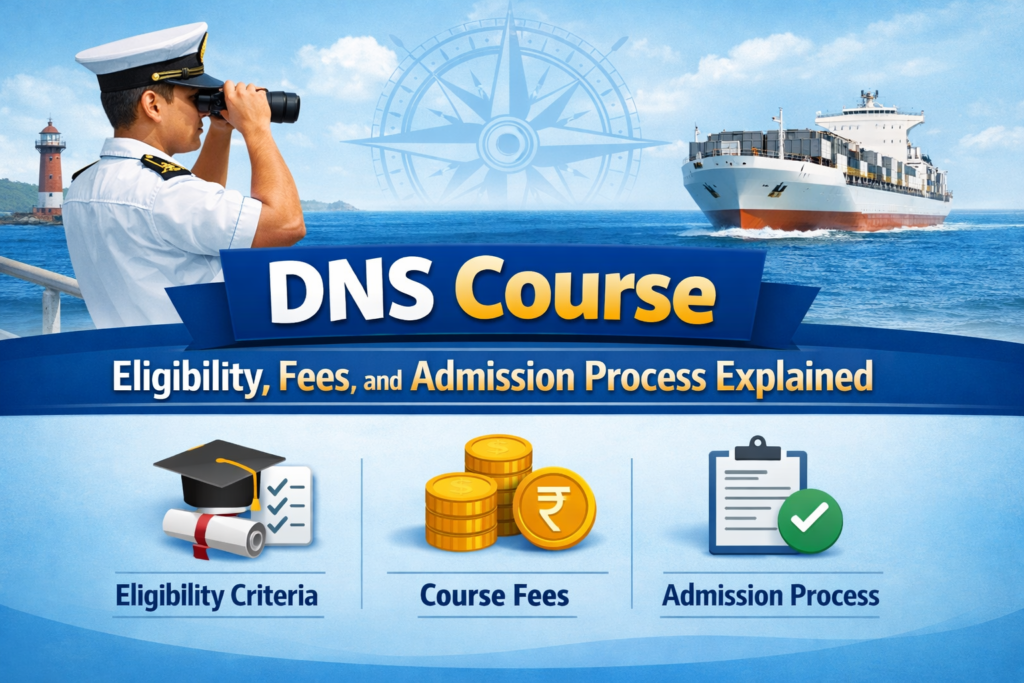
DNS Course Eligibility, Fees, and Admission Process Explained
Introduction to DNS Course
If you’re dreaming of a career at sea—exploring oceans, earning a strong income, and living an adventurous life—then the Diploma in Nautical Science (DNS) might be the perfect start. DNS is a popular maritime course that leads to a career as a Deck Officer on merchant ships.
What is DNS?
DNS is a 1-year pre-sea training program approved by the Directorate General of Shipping (DGS), Government of India. After completing this course, students must undergo 18 months of onboard training, eventually leading them to become Deck Officers.
Why choose a DNS career?
Because who doesn’t want a job where the “office view” is literally the ocean?
A career in merchant navy offers:
- High salary packages
- Global travel
- Tax benefits
- Fast career promotions
- Adventure + stability
DNS Course Eligibility Criteria
Before jumping into the admission process, let’s decode the rules you must meet.
Educational Qualifications
You can apply through any of these routes:
- 10+2 (PCM) with 60% aggregate
- Physics, Chemistry, Math: Minimum 60%
- English (Class 10 or 12): Minimum 50%
- B.Sc. graduates
- B.Sc. in Physics / Math / Chemistry with at least 55% marks
- B.Tech graduates
- Minimum 50% marks
Age Requirements
- Minimum age: 17 years
- Maximum age: 25 years (For 10+2 candidates)
- Age relaxation may apply as per DGS rules.
Medical Fitness Standards
Merchant navy = disciplined + medically fit lifestyle.
- Must be medically fit as per DG Shipping norms
- Must pass medical test by DGS-approved doctor
Physical Standards
Eye Vision Requirements
- 6/6 vision without glasses
- No color blindness
- No night blindness
This is where many students fail—so don’t ignore your eyesight.
BMI Requirements
- BMI must fall under 18.5 to 25
Mandatory Entrance Exams
Most colleges require students to clear:
- IMU CET (Indian Maritime University Common Entrance Test)
- Some institutes conduct their own test & interview.
DNS Course Duration and Structure
Course Length
- 1-year pre-sea training
Followed by:
Training Components
- Classroom training
- Simulator training
- Workshops
- Maritime safety training (STCW)
- Fire safety, survival at sea
Onboard Training After Course Completion
After college, students join ships as Deck Cadets for 18 months of sea time, which is necessary for the 2nd Mate exam.
DNS Course Fees
The cost of DNS varies based on the institute.
Government Colleges Fee Structure
- Fees typically range from ₹2,50,000 – ₹3,50,000 per year
- Hostel & mess extra
Private Colleges Fee Structure
- Fees range from ₹4,00,000 – ₹7,00,000 per year
- Some top academies may charge slightly more
Additional Expenses
- Medical test: ₹3,000 – ₹5,000
- Uniform: ₹8,000 – ₹12,000
- Books/Stationery: ₹3,000 – ₹5,000
- Passport (if not available): ₹1,500 – ₹2,000
Top DNS Colleges in India
Government Institutes
- Indian Maritime University (IMU) campuses
- TS Chanakya
- IMU Chennai
Private Maritime Academies
- Anglo-Eastern Maritime Academy
- Great Eastern Institute of Maritime Studies
- Tolani Maritime Institute
- AMET University
- Samundra Institute of Maritime Studies
- International Maritime Institute Noida
- Ganpat University
- Seven Island
- Shipping Corporation of India
- Maharashtra Academy of Naval Education and Training Pune
Always check whether the institute is DGS-approved.
DNS Admission Process
Step-by-Step Admission Process
- Check eligibility
- Register for IMU CET
- Clear the exam
- Apply to DG-approved colleges
- Attend interview & psychometric test
- Undergo medical test
- Receive offer letter
- Pay fees & join the course
Required Documents
- 10th & 12th mark sheets
- Birth certificate
- Passport-size photographs
- Medical fitness certificate
- IMU CET score
- ID proof (Aadhar/PAN)
Admission Deadlines
- IMU CET generally held twice a year
- Admissions usually open from April to July
Selection Process
- Entrance exam score
- Interview performance
- Psychometric test
- Medical fitness
Career After DNS
Job Role Onboard
After the course and onboard training, you join a ship as a Deck Cadet. Your duties include:
- Navigation
- Watchkeeping
- Cargo operations
- Ship maintenance
Promotion Pathway
- Deck Cadet
- Third Officer
- Second Officer
- Chief Officer
- Captain (Master Mariner)
Becoming a Captain is the ultimate goal—and yes, the salary is worth the effort.

Salary Expectations
- Deck Cadet: ₹30,000 – ₹70,000 per month
- After becoming an officer: ₹2 lakh – ₹3 lakh per month
- Chief Officer & Captain: ₹6 lakh – ₹10+ lakh per month
Tips to Crack DNS Entrance Exams
IMU CET Preparation
- Focus on PCM of 11th & 12th
- Solve mock tests
- Follow NCERT books
Fitness Preparation
- Start exercising at least 2 months before
- Maintain healthy BMI
- Get eyesight checked early
Common Mistakes Students Make
Ignoring Eyesight Requirements
The biggest reason candidates get rejected is poor eyesight. Don’t ignore this.
Choosing Non-DG-Approved Colleges
If it’s not approved by DG Shipping, your certificate is useless. Always verify.
Conclusion
The DNS course is an excellent career path for students who want to build a future in the merchant navy. With proper eligibility, medical fitness, and dedication, you can join one of the most respected and high-paying professions in the world. The course opens the door to global travel, a disciplined lifestyle, and an adventurous career at sea. If you’re committed, physically fit, and passionate, DNS can truly shape your future.
FAQs
1. What is the minimum PCM percentage for DNS?
You need at least 60% in PCM in 12th standard.
2. What is the age limit for DNS?
The maximum age is 25 years for 10+2 candidates.
3. Can I join DNS if I wear glasses?
No, DNS requires 6/6 unaided vision.
4. Is IMU CET mandatory?
Yes, for most institutes IMU CET is required.
5. How much salary can I expect after DNS?
Fresh Deck Cadets earn between ₹30,000 to ₹70,000, and salaries increase significantly with rank.