
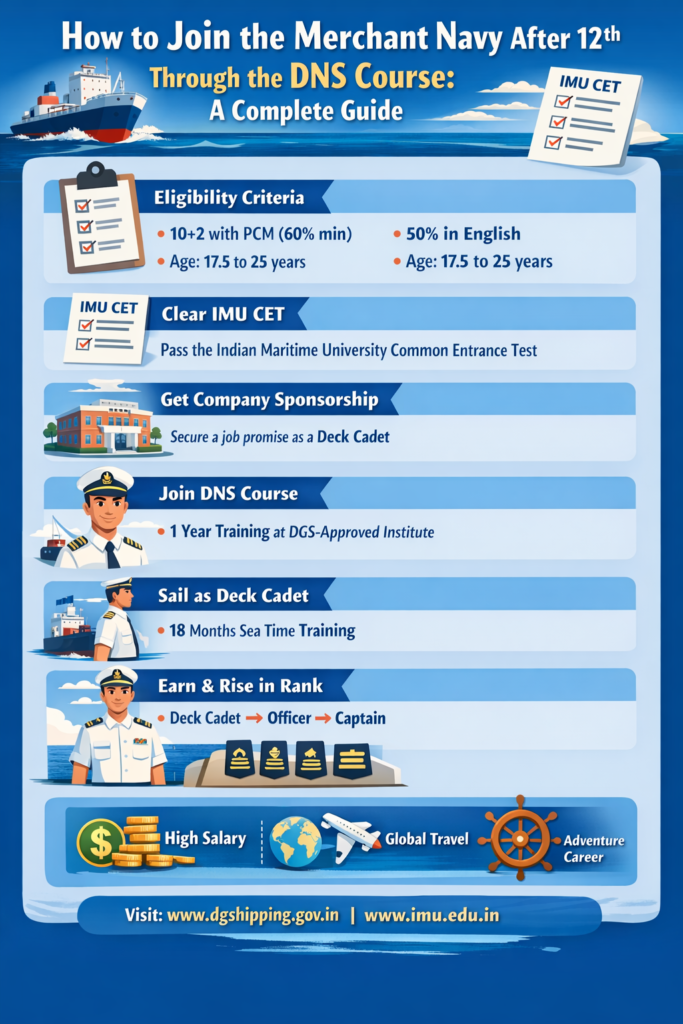
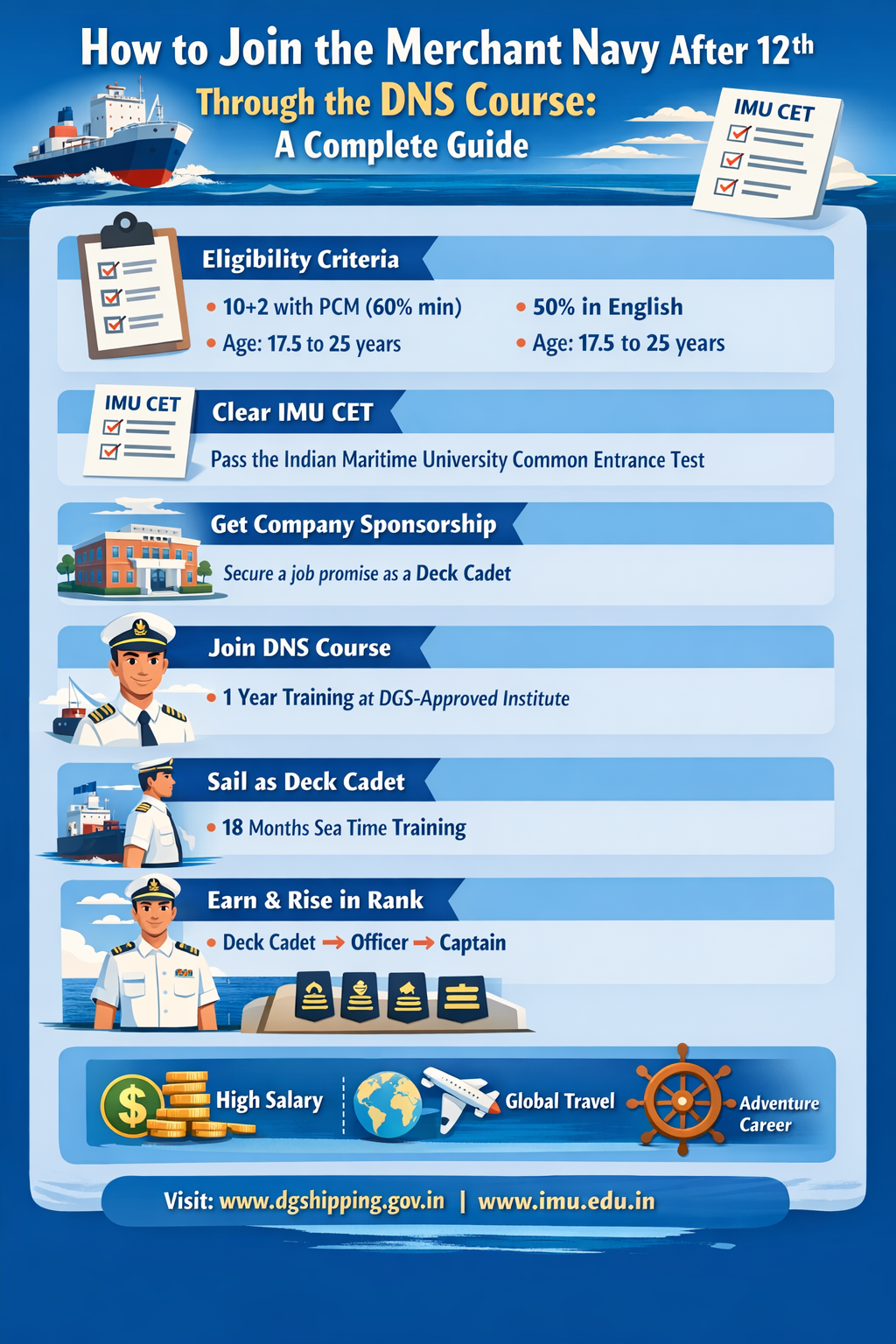
How to Join the Merchant Navy After 12th Through the DNS Course: A Complete Guide
how to join merchant navy after 12th, merchant navy after 12th, DNS course after 12th, diploma in nautical science, merchant navy DNS course, deck cadet after 12th, join merchant navy in India. If you dream of working on massive ships that look like floating cities, the Merchant Navy might be calling your name. And guess what? You don’t need an engineering degree or a pile of certificates to start. You can begin your journey right after 12th through the Diploma in Nautical Science (DNS) course.
This guide explains everything you need to know—eligibility, admission process, training, job roles, salary expectations, and trusted official sources. Let’s break it down with clarity, logic, and just the right pinch of humour (because long articles without humour feel like long voyages without Wi-Fi).
What Is the DNS Course?
The Diploma in Nautical Science (DNS) is a one-year residential pre-sea training program approved by the Directorate General of Shipping (DGS), Government of India.
After the DNS program, cadets join ships as Deck Cadets and start accumulating sea-time to become officers.
Trusted Sources:
- Directorate General of Shipping (DGS India): dgshipping.gov.in
- Indian Maritime University (IMU): imu.edu.in
Why DNS Is the Best Route After 12th
Choosing DNS is the fastest and most direct path to becoming a Navigation Officer in the Merchant Navy. Students love this path because:
- You start your career early
- You travel across the world
- You earn in USD on foreign-going ships
- You follow a clear promotion roadmap
- You avoid long years of college fees
And yes, you get cool pictures for Instagram with captions like “Sunset somewhere in the Atlantic.”
Eligibility Criteria: Are You Qualified?
Before dreaming about global sea routes, you need to meet specific requirements set by the DGS, IMU, and shipping companies.
1. Educational Qualification
You must have:
- 10+2 with Physics, Chemistry, Maths (PCM)
- Minimum 60% aggregate in PCM
- Minimum 50% in English (either in 10th or 12th)
Source: DGS Minimum Qualification Standards (dgshipping.gov.in)
2. Age Limit
- Minimum: 17.5 years
- Maximum: 25 years
(Some companies offer age relaxation as per DGS norms.)
3. Medical Fitness
You must be medically fit as per MS Medical Examination Rules 2000.
- No colour blindness
- Perfect or corrected 6/6 vision
- Physically fit for sea service
Source: DGS Medical Standards & Approved Medical Examiners List
4. IMU CET Requirement
Most institutes require you to clear IMU CET (Indian Maritime University Common Entrance Test).

Admission Process: Step-by-Step Guide
Joining the Merchant Navy through DNS is a straightforward process, but many students get confused because there are multiple steps. Let’s simplify it.
Step 1: Clear IMU CET
IMU CET is conducted once a year for maritime courses.
It includes:
- Maths
- Physics
- English
- Logical reasoning
- General aptitude
Score well and you unlock the gateway to reputed DGS-approved institutes.
Step 2: Apply to DGS-Approved Institutes
Popular institutions offering DNS include:
- IMU-affiliated colleges
- T.S. Rahaman, Mumbai
- Tolani Maritime Institute
- AMET University
- Great Eastern Institute of Maritime Studies (GEIMS)
- Samundra Institute of Maritime Studies (SIMS)
- Maharashtra Academy of Naval Education and Training (MANET)
- International Maritime Institute Noida (IMI)
- Ganpat University
- Himt Chennai
These colleges often conduct:
- Written tests
- Psychometric tests
- Panel interviews
(Check institute websites and DGS list to ensure genuine approval.)
Step 3: Company Sponsorship (Very Important!)
Sponsorship means a shipping company guarantees you a job as a Deck Cadet after completing DNS.
Companies conducting sponsorship tests include:
Fleet Management
- Anglo-Eastern
- Maersk
- Wilhelmsen
- Synergy Marine
- Bernhard Schulte
- ESP Shipping
- TOM Tankers
- MSC Shipping
- MTM Shipping
Each company follows a structured selection process including:
- Aptitude test
- English & Maths test
- MARLINS (English proficiency)
- Psychometric assessment
- Personal interview
- Medical examination
Tip: Always secure sponsorship BEFORE joining college. This ensures a smooth career start.
Step 4: Join DNS Course
Once you secure sponsorship and get admission, your one-year NSQF Level 5 DNS program begins.
- This includes:
- Navigation
- Rules of the Road at Sea (COLREG)
- Ship stability
- Cargo handling
- Marine meteorology
- Seamanship
- Survival techniques
- Fire prevention and firefighting
- Practical bridge simulator sessions
It’s not just classroom work. You also learn to throw ropes, launch lifeboats, and handle firefighting equipment—skills that sound like movie stunts but are essential at sea.
Life After DNS: Sea Time & Cadetship
After completing your DNS program, you join a vessel as a Deck Cadet.
- Your primary goals are:
- Completing 18 months of sea-time (as per DGS norms)
- Learning watchkeeping
- Participating in cargo operations
- Training under Chief Officer and Captain
This phase builds your foundation as a future officer.
And yes, you start earning (in USD, mind you).

Career Growth: From Deck Cadet to Captain
Here’s the clear promotion path:
1. Deck Cadet → Third Officer
After 18 months sea-time + exams (2nd Mate CoC)
2. Third Officer → Second Officer
With required experience and training
3. Second Officer → Chief Officer
After passing Chief Mate exams
4. Chief Officer → Captain (Master Mariner)
Final professional exam + required sea service
Every rank brings higher salary, responsibility, and bragging rights.
Salary After DNS: What You Can Expect
One big reason students join the Merchant Navy is the attractive salary.
Below are average industry figures (varies by company and vessel type):
- Deck Cadet: USD 300–700 per month
- Third Officer: USD 2,500–4,000
- Second Officer: USD 4,000–6,000
- Chief Officer: USD 8,000–12,000
- Captain: USD 12,000–18,000+
Source: Publicly available salary data from Fleet Management, Anglo-Eastern, Bernhard Schulte & maritime recruitment portals.
These numbers naturally change based on:
- Vessel type (tankers pay more)
- Company standards
- Global market conditions
But overall, Merchant Navy officers earn some of the highest salaries available to 12th-pass students in India.
Is DNS a Safe and Reliable Career Path?
Yes, provided you:
- Choose a DGS-approved institute
- Secure company sponsorship
- Follow legitimate procedures
- Maintain good discipline and fitness
Thousands of Indian seafarers work across global fleets, making India one of the largest suppliers of maritime professionals.
Top Advantages of Joining Merchant Navy After DNS
1. Global travel
You work in the ocean, but you see the world.
2. Foreign currency salary
USD looks better than INR (that’s just maths, not arrogance).
3. Early career start
You start earning at 18–19.
4. Fast promotions
Your progress depends on skill and exams, not office politics.
5. Job security
Global shipping always needs officers.
Challenges You Should Know Before Joining
A good article isn’t complete without honesty. Merchant Navy life also includes:
Long months away from home
Working in bad weather
Strict discipline
Demanding schedules
Isolation at sea
If you enjoy adventure, teamwork, and resilience, you’ll do well.
Official Sources You Must Check
These websites keep you safe from fake agents and fraudulent institutes:
Directorate General of Shipping, India
https://dgshipping.gov.in
Indian Maritime University (IMU)
https://imu.edu.in
DGS-approved institute list
Available on DGS website under “Maritime Training Institutes”
Scores, eligibility, medical rules, and institutes should always be verified from these official portals.
Final Thoughts: Should You Choose DNS After 12th?
Absolutely—if you want:
- A global career
- A high salary
- Adventure-packed life
- Early financial independence
- A professional path with clear growth
The DNS course is the smartest and most efficient route to join the Merchant Navy right after school.
It demands hard work, discipline, and courage, but it rewards you with a unique lifestyle that few careers can match.
Just remember: always choose a DGS-approved college, secure sponsorship, and keep your documents genuine and verified.
If the sea feels like your calling, this is your chance. The world’s oceans are waiting.