

Marine Emergency Generator on Ships: SOLAS Rules, Working and Testing Guide

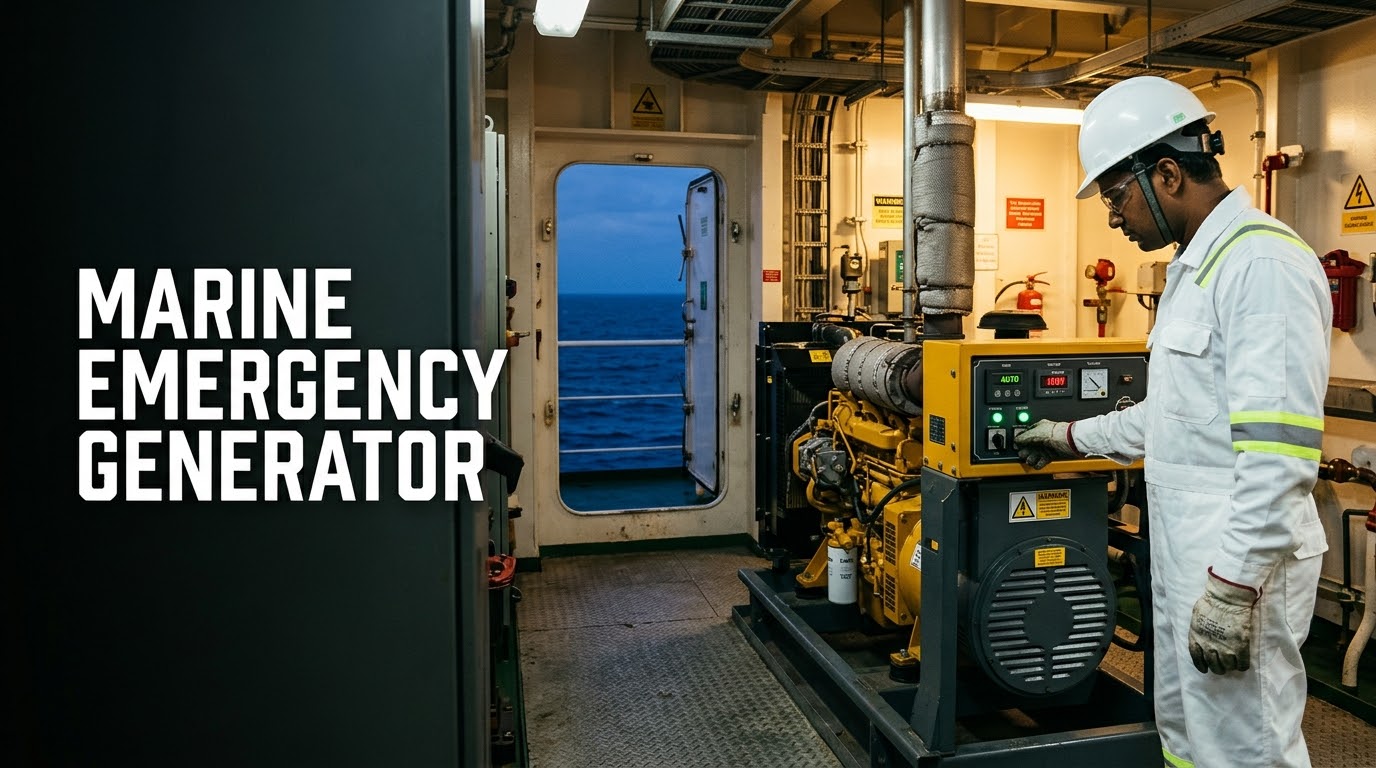
Last Updated: October 2026 · By V.K. Singh · Fleet Frontier
A marine emergency generator is the ship’s last line of electrical defence. When the main generators trip and the ship goes into blackout, this self-contained diesel set starts on its own, connects to the emergency switchboard and keeps the lights, radios, fire pump and steering alive. Under SOLAS, it must be on load within 45 seconds and run essential services for 18 hours on cargo ships and 36 hours on passenger ships.
In this guide, you will learn what the emergency generator is, the exact SOLAS Chapter II-1 rules behind it, where it is fitted, how it starts, how engineers test it on board, and why it sometimes fails when it is needed most. It is written for engine cadets, ETO and marine engineering students, and officers preparing for orals.
Quick Answer

What is a marine emergency generator? It is a self-contained, usually diesel-driven generator located above the uppermost continuous deck that automatically supplies the emergency switchboard when main power fails. SOLAS II-1 Regulations 42–44 require it to start and take load within 45 seconds and power essential services for 18 hours (cargo ships) or 36 hours (passenger ships).
What Is a Marine Emergency Generator?
Every SOLAS ship has two levels of electrical supply:
- Main source of power — the main diesel generators (and shaft generator, if fitted) in the engine room, feeding the main switchboard.
- Emergency source of power — an emergency generator or, on some ships, a large accumulator battery, feeding a separate emergency switchboard.
The emergency generator — often called the EDG (emergency diesel generator) — sits idle in AUTO mode for most of its life. It has its own fuel tank, its own starting system and its own switchboard, so a fire, flood or fault in the engine room cannot take it down together with the main plant.
Think of it this way: the main generators run the ship; the emergency generator keeps the crew safe and the ship controllable long enough to restore power or abandon ship in an orderly way.
Emergency generator vs auxiliary generator
| Feature | Auxiliary (main) generator | Emergency generator |
|---|---|---|
| Purpose | Normal ship power | Safety loads only |
| Location | Engine room | Above uppermost continuous deck |
| Feeds | Main switchboard | Emergency switchboard |
| Normal state | Running | Standby in AUTO |
| Fuel | Ship’s fuel system | Independent tank |
SOLAS Requirements for the Emergency Generator
The rules sit in SOLAS Chapter II-1, Part D:
- Regulation 42 — emergency source of power in passenger ships
- Regulation 43 — emergency source of power in cargo ships
- Regulation 44 — starting arrangements for emergency generating sets
India applies these through DG Shipping (DGMA) as flag administration, and classification societies build them into their rules. The key requirements are summarised below.
| Requirement | What SOLAS says (summary) |
|---|---|
| Type | Self-contained generator or accumulator battery |
| Location | Above uppermost continuous deck, readily accessible from open deck, not forward of collision bulkhead |
| Auto start | Starts automatically and connects to emergency switchboard; if this cannot happen within 45 s, a transitional source is needed |
| Fuel | Independent supply; flash point not less than 43°C |
| Ship attitude | Must work at up to 22.5° list and 10° trim |
| Cold start | Must start readily at 0°C; heating needed if colder conditions are expected |
| Duration | 18 h (cargo ships), 36 h (passenger ships) for most services |
Source: SOLAS Chapter II-1, Regulations 42–44 (consolidated text). Readers preparing for exams should refer to the latest consolidated SOLAS edition.
Which Loads Does the Emergency Generator Supply?
The emergency switchboard carries only what is needed for safety. Typical loads on a cargo ship include:
| Emergency service | Cargo ship | Passenger ship |
|---|---|---|
| Lighting at muster & embarkation stations, over the side | 3 h | 36 h |
| Emergency lighting in alleyways, stairways, machinery spaces, bridge, ECR | 18 h | 36 h |
| Navigation lights | 18 h | 36 h |
| VHF/MF radio (GMDSS), internal communication, fire detection, general alarm | 18 h | 36 h |
| Emergency fire pump (if electric) | 18 h | 36 h |
| Steering gear (one unit) | 30 min (≥10,000 GT) / 10 min (others) | Same, per Reg. 29.14 |
For passenger ships on short international voyages, the Administration may accept a reduced period of not less than 12 hours.
Practical example: On a 60,000 DWT bulk carrier, the EDG might be rated around 150–300 kW. That is a small fraction of the main plant, because it only carries the emergency board — not the galley, air-conditioning, cargo pumps or main engine auxiliaries. Actual rating depends entirely on the ship’s load analysis.
Where Is the Emergency Generator Located?

SOLAS location rules are designed so that one casualty cannot kill both power sources:
- Above the uppermost continuous deck — so flooding of the hull does not reach it.
- Readily accessible from the open deck — crew can reach it during an engine room fire.
- Not forward of the collision bulkhead.
- As far as practicable, not contiguous to Category A machinery spaces or the main switchboard space. Where this is unavoidable, structural fire protection is required.
On most cargo ships you will find the emergency generator room on the poop deck or upper deck level of the accommodation block, usually aft, with its own ventilation louvres and an independent fuel tank inside or next to the room.
How the Emergency Generator Starts Automatically

When the main switchboard goes dead, this sequence happens in a few seconds:
- Undervoltage detected on the emergency switchboard bus (fed from the main switchboard via an interconnector).
- Interconnector breaker opens, isolating the emergency board from the dead main board.
- Start signal goes to the EDG starter motor.
- Engine runs up to rated speed; voltage and frequency build up through the AVR.
- EDG breaker closes and the emergency switchboard is energised.
- When main power returns, the emergency board is switched back, the EDG breaker opens and the engine cools down before stopping.
An interlock prevents the EDG from running in parallel with the main generators continuously, so a fault on one side cannot back-feed the other.
Transitional source of emergency power
Some lights and alarms cannot wait even 45 seconds. That is why a transitional source — a battery bank — supplies emergency lighting and key alarms the instant power is lost.
- Passenger ships: transitional source is always required, for 30 minutes.
- Cargo ships: required unless the emergency generator can start and take load within 45 seconds.
Starting Arrangements (SOLAS Regulation 44)
This is a favourite oral exam question. The emergency generator must have:
| Item | Requirement |
|---|---|
| Primary starting device | Stored energy for at least three consecutive starts |
| Second source of energy | Three additional starts within 30 minutes, unless manual starting is shown to be effective |
| Cold start | Must start readily at 0°C |
| Stored energy | Kept charged/maintained at all times |
Common starting methods on Indian-crewed fleets:
- Electric start (24 V DC battery) — the most common primary method.
- Hydraulic accumulator start — often fitted as the second source; recharged by hand pump.
- Spring start — on smaller sets; wound by hand.
- Air start — less common; needs its own air bottle.
If the EDG fails to start, an alarm must be given (typically in the ECR), so the watchkeeper can try the secondary method.
Fuel, Cooling and Engine Type
- Fuel: Marine gas oil/distillate (DMA) with flash point not below 43°C, from an independent tank. Heavy fuel oil is not used.
- Engine type: Usually a high-speed four-stroke diesel (1500 rpm at 50 Hz, 1800 rpm at 60 Hz), chosen for fast start and compact size.
- Cooling: Usually radiator-cooled with an engine-driven fan, so it does not depend on the ship’s sea-water system.
- Emissions: Under MARPOL Annex VI Regulation 13, a marine diesel engine intended to be used solely in case of emergency is excluded from the NOx Tier limits. Owners may still buy Tier II-certified engines, but Tier III is not a legal requirement for an emergency-only set.
Emergency Generator vs Other Emergency Power Options
| Option | Where used | Advantage | Limitation |
|---|---|---|---|
| Diesel emergency generator | Almost all cargo and passenger ships | Long duration, proven | Needs regular testing and fuel care |
| Accumulator battery as emergency source | Small ships, some special craft | Instant power, no engine | Heavy and bulky for 18–36 h |
| Battery + diesel (transitional + EDG) | Standard on passenger ships | No-break lighting, long duration | More equipment to maintain |
How Engineers Test the Emergency Generator On Board

SOLAS requires that the complete emergency system — including automatic starting — can be periodically tested. The actual frequency is set by the company’s Safety Management System (SMS), flag and class. The routine below reflects common industry practice, not a SOLAS-fixed schedule.
| Test | Typical frequency (company practice) | What is checked |
|---|---|---|
| No-load run | Weekly | Start on battery, oil pressure, temperature, charger working |
| Secondary start test | Weekly or monthly | Hydraulic/spring start works |
| Auto-start (simulated blackout) | Monthly or as per SMS | Auto start, breaker closing, load taken within 45 s |
| On-load test | Periodically, as per SMS/class | Voltage and frequency stable under real load |
| Class survey | Annual/renewal surveys | Surveyor witnesses start and load test |
Simulated blackout test (typical steps):
- Inform the bridge and Chief Engineer; get permission.
- Confirm the EDG is in AUTO and the batteries are fully charged.
- Open the interconnector breaker between the main and emergency switchboards (as per the ship’s procedure).
- Note the time from blackout to EDG breaker closing — it must be within 45 s.
- Check voltage, frequency, oil pressure and cooling water temperature.
- Confirm emergency lighting, nav lights and key consumers are live.
- Restore normal supply, let the EDG cool down and stop.
- Return the EDG to AUTO and record the test in the engine log book and PMS.
A practical tip for cadets: the most common finding during audits and PSC inspections is an EDG left in MANUAL after a test. Always confirm AUTO mode before leaving the room.
Common Reasons an Emergency Generator Fails to Start
| Problem | Typical cause | Prevention |
|---|---|---|
| Engine does not crank | Flat or weak battery, failed charger, loose terminals | Weekly battery and charger checks |
| Cranks but does not fire | Water or sediment in fuel, air in fuel line, low tank level | Drain tank, keep tank topped up |
| Hydraulic start fails | Low accumulator pressure, leaking seals | Check pressure, recharge after each test |
| Starts but trips | Low lube oil pressure, high temperature, overspeed setting | Check levels, test trips properly |
| No auto start | Selector left in MANUAL, faulty undervoltage relay | Return to AUTO after every test |
| Does not take load | Breaker fault, AVR fault | Include breaker closing in every auto test |
| Fails in cold climate | No preheating, weak battery | Use jacket-water heater below 0°C |
Port State Control inspectors regularly ask crew to start the emergency generator during inspections. A failure here is a common deficiency and can lead to detention if it shows the ship’s maintenance system is not working.
Real-World Lesson: Carnival Dream (2013)
In March 2013, the cruise ship Carnival Dream reported a problem with its emergency diesel generator while alongside in St. Maarten. The fault led to temporary disruptions of services such as elevators and toilets, and the voyage was cut short with guests flown home.
The lesson for engineers is simple: the emergency generator is a safety system, but it is also a machine that needs proper maintenance, regular testing and correct settings. Faults found during routine tests are far cheaper than faults found during a real blackout.
Crew Responsibilities
- Fourth/Third Engineer: Weekly runs, battery and fuel checks, log entries.
- ETO/Electrical Officer: Battery chargers, AVR, breakers, undervoltage relays, emergency switchboard insulation.
- Second Engineer: Planning tests and maintenance in PMS.
- Chief Engineer: Overall readiness; witnesses tests and surveys.
- Bridge team: Know which equipment is on the emergency board and how to respond to a blackout.
During a real blackout, one engineer typically goes straight to the emergency generator room to confirm it has started and taken load, while others work on restoring main power.
Pre-Voyage Emergency Generator Checklist
- Fuel tank level sufficient for the required duration; tank drained of water
- Lube oil and coolant levels correct
- Starting batteries charged; charger working; terminals clean
- Hydraulic accumulator pressure correct / spring start serviceable
- Ventilation louvres open and unobstructed
- No alarms on the control panel
- Selector switch in AUTO
- Last test recorded in the log book and PMS
Key Takeaways
- The emergency generator is required by SOLAS Chapter II-1, Regulations 42–44.
- It must start automatically and supply the emergency switchboard within 45 seconds.
- It must supply essential services for 18 hours on cargo ships and 36 hours on passenger ships.
- It sits above the uppermost continuous deck with an independent fuel supply (flash point ≥43°C).
- It needs three consecutive starts plus a second source for three more starts within 30 minutes.
- Test frequency comes from the SMS, flag and class — weekly runs and regular auto-start tests are common practice.
Conclusion
The marine emergency generator is small compared with the main power plant, but it carries a big responsibility. It keeps the ship visible, controllable and in contact with the world when everything else has failed. For engine cadets and junior engineers, knowing its SOLAS requirements is essential for orals — but knowing how to test it, keep it in AUTO and fix it when it refuses to start is what makes you a dependable engineer on board.
Disclaimer: This article summarises SOLAS requirements for educational purposes. Specific requirements may differ by ship type, flag and classification society. Always follow the ship’s Safety Management System, the manufacturer’s manual and the latest consolidated SOLAS text.
13. FAQ Section
1. What is a marine emergency generator? It is a self-contained, usually diesel-driven generator that automatically supplies a ship’s emergency switchboard when the main power fails.
2. Within how many seconds must the emergency generator start? Under SOLAS, it must start and supply the emergency switchboard within 45 seconds. If it cannot, a transitional battery source is required.
3. How long must an emergency generator supply power? For most essential services, 18 hours on cargo ships and 36 hours on passenger ships.
4. Where is the emergency generator located on a ship? Above the uppermost continuous deck, readily accessible from the open deck, and not forward of the collision bulkhead.
5. Which SOLAS regulation covers the emergency generator? SOLAS Chapter II-1, Regulation 42 (passenger ships), Regulation 43 (cargo ships) and Regulation 44 (starting arrangements).
6. What is the minimum fuel flash point for an emergency generator? The fuel must have a flash point of not less than 43°C.
7. How many starts must the emergency generator starting system provide? At least three consecutive starts from the primary source, plus a second source for three more starts within 30 minutes unless manual starting is effective.
8. What is the transitional source of emergency power? A battery bank that instantly supplies emergency lighting and key alarms until the emergency generator takes load. Passenger ships must have it for 30 minutes.
9. Can a battery replace the emergency generator? Yes. SOLAS allows an accumulator battery as the emergency source, but it must carry the full emergency load for the required period without recharging.
10. Does the emergency generator need to meet IMO Tier III? No. Engines used solely for emergencies are excluded from MARPOL Annex VI NOx Tier limits.
11. How often is the emergency generator tested on board? Frequency is set by the company SMS, flag and class. Weekly no-load runs and regular simulated blackout tests are common practice.
12. What is the difference between an emergency and an auxiliary generator? Auxiliary generators supply normal ship power from the engine room. The emergency generator is independent, located outside the engine room and supplies only safety-critical loads.
emergency generator on ship, emergency generator SOLAS requirements, emergency diesel generator (EDG), emergency switchboard on ship, transitional source of emergency power, emergency generator starting arrangements, emergency generator must start within how many seconds, emergency generator 18 hours cargo ship 36 hours passenger ship, where is the emergency generator located on a ship, emergency generator fuel flash point SOLAS, how to test emergency generator on ship, emergency generator viva questions for engine cadets