

Difference Between DNS, B.Sc Nautical Science, and B.Tech Marine Engineering
Choosing a career in the Merchant Navy feels exciting—until you face the big question: DNS, B.Sc Nautical Science, or B.Tech Marine Engineering?
All three courses sound nautical, professional, and promising. Yet, they lead to very different lives at sea.
This guide breaks everything down in plain English. No myths. No fake data. Just real facts, logic, and a little humor—because career decisions should not feel like solving a marine engine manual without pictures.
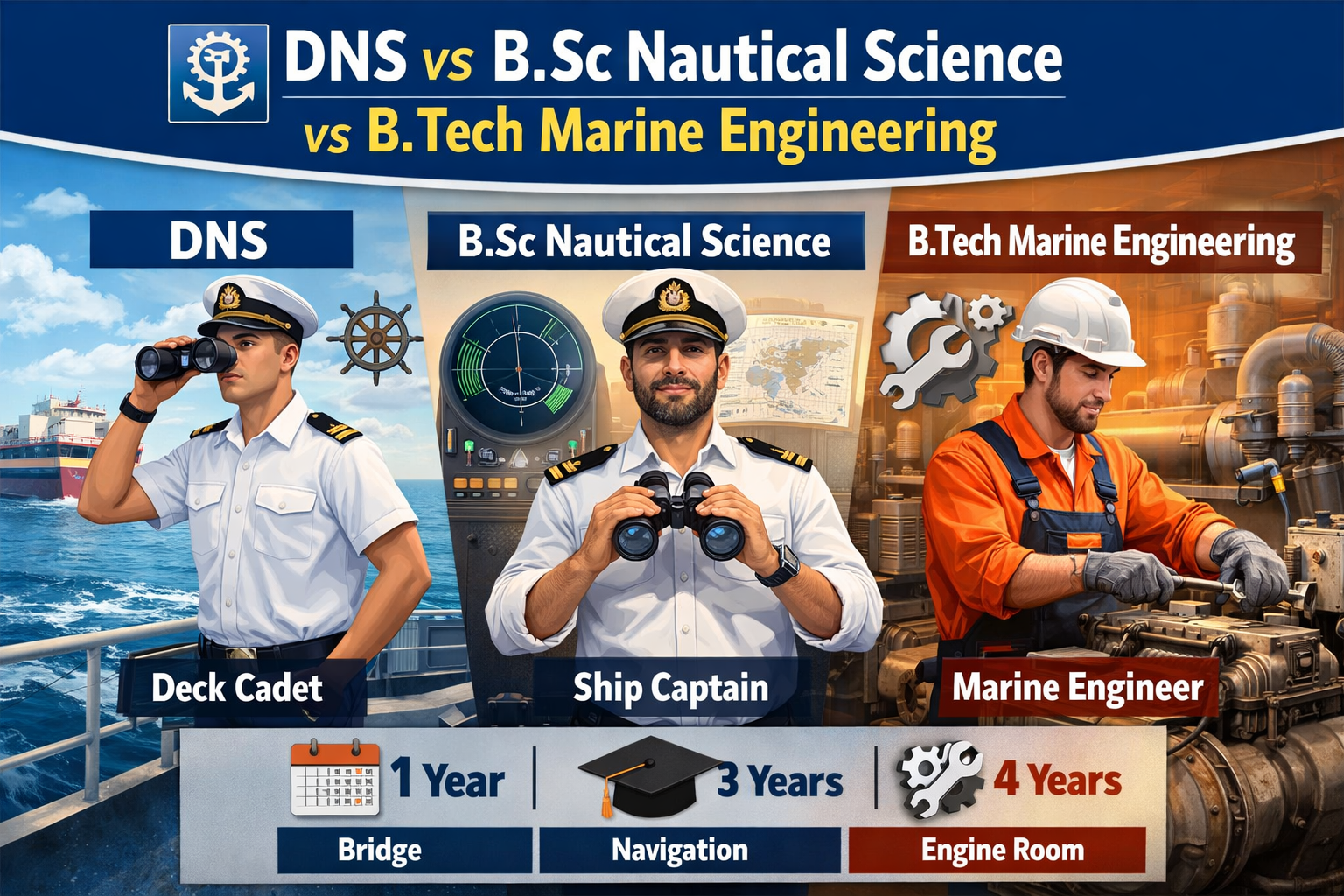

Understanding the Merchant Navy Career Paths
The Merchant Navy has two main departments onboard ships:
- Deck Department – Navigation, cargo operations, ship handling
- Engine Department – Machinery, engines, power generation
DNS and B.Sc Nautical Science belong to the deck side.
B.Tech Marine Engineering belongs to the engine side.
That single difference changes everything—from daily work to future promotions.
What Is Diploma in Nautical Science (DNS)?
DNS Course Overview
DNS is the fastest route to become a navigating officer.
It is a 1-year pre-sea diploma, followed by structured sea training.
Think of DNS as a sprint, not a marathon. You enter the sea life quickly, but you must stay disciplined.
Eligibility Criteria for DNS
- 10+2 with Physics, Chemistry, Mathematics
- Minimum 60% aggregate
- English: Minimum 50%
- Age: Usually 17.5 to 25 years
- Must pass DG Shipping medical standards
Career Path After DNS
After completing DNS:
- Join ship as Deck Cadet
- Clear Second Mate (FG) exam
- Become Third Officer
- Progress to Chief Mate
- Finally, Captain (Master Mariner)
DNS demands self-study and exam discipline. No spoon-feeding here.
What Is B.Sc Nautical Science?
Course Structure
B.Sc Nautical Science is a 3-year undergraduate degree.
It combines academics with structured maritime training.
If DNS is a sprint, B.Sc Nautical Science is a steady jog with guidance.
Eligibility Requirements
- 10+2 with PCM
- Minimum 60% marks
- English proficiency required
- DG Shipping medical fitness mandatory
Career Progression
Graduates join ships as Deck Cadets or Trainee Officers.
They follow the same promotion ladder as DNS students—but with stronger academic grounding.
What Is B.Tech Marine Engineering?
Course Overview
B.Tech Marine Engineering is a 4-year engineering degree.
This course prepares you for the engine room, not the bridge.
If you love machines, sound of engines, and problem-solving, this is your ocean.
Eligibility Criteria
- 10+2 with PCM
- Minimum 60% marks
- Strong mathematics and physics understanding
- DG Shipping approved medical fitness
Career Growth
- Join ship as Engine Cadet (Junior Engineer)
- Clear Class IV, II, and I exams
- Become Chief Engineer
Chief Engineers control the ship’s power—without them, ships don’t move an inch.
Key Differences Between DNS, B.Sc Nautical Science, and B.Tech Marine Engineering
Course Duration
- DNS: 1 year (pre-sea)
- B.Sc Nautical Science: 3 years
- B.Tech Marine Engineering: 4 years
Onboard Roles
- DNS & B.Sc: Navigation, cargo, ship safety
- B.Tech: Engines, generators, fuel systems
Academic Depth
- DNS: Practical, fast-track
- B.Sc: Balanced academic + practical
- B.Tech: Deep engineering knowledge
Comparison Table
| Feature | DNS | B.Sc Nautical Science | B.Tech Marine Engineering |
| Course Duration | 1 Year | 3 Years | 4 Years |
| Department | Deck | Deck | Engine |
| Entry Rank | Deck Cadet | Deck Cadet | Junior Engineer |
| Final Rank | Captain | Captain | Chief Engineer |
| Academic Level | Diploma | Degree | Engineering Degree |
| Best For | Quick sea entry | Balanced approach | Technical minds |
Which Course Is Best for You?
If You Want to Be on the Bridge
Choose DNS or B.Sc Nautical Science.
You will navigate ships, handle cargo, and command vessels.
If You Love Machines
Choose B.Tech Marine Engineering.
You will manage engines, solve breakdowns, troubleshooting and keep the ship alive.


Salary Expectations (Reality Check)
Let’s be honest—salary depends on company, ship type, and experience.
- Junior Officers: ₹1.5–3 lakh/month
- Senior Officers: ₹5–10 lakh/month
- Captain / Chief Engineer: ₹10–15 lakh/month
No shortcuts. Experience rules the sea.
Job Stability and Career Longevity
Merchant Navy offers:
- Global demand
- Tax benefits (subject to residency rules)
- Career till 50–60 years
But yes, sea life demands discipline, health, and sacrifice.
Medical and Physical Requirements
All courses require:
- Good eyesight (with limits)
- No color blindness
- Physical fitness as per maritime standards
Fail medical = career blocked. Always check before admission.
Common Myths About Merchant Navy Courses
Myth 1: DNS is inferior
Truth: DNS leads to Captain rank, same as degree holders.
Myth 2: Engineering earns more
Truth: Rank matters, not department.
Myth 3: Sea life is easy money
Truth: It’s earned with sweat, stress, and storms.
Final Verdict
There is no best course—only the right course for you.
- Choose DNS if you want speed and discipline
- Choose B.Sc if you want structure and academics
- Choose B.Tech if machines excite you more than maps
Ships don’t care about confusion. Choose wisely before you sail.
Conclusion
DNS, B.Sc Nautical Science, and B.Tech Marine Engineering all lead to respected, high-paying maritime careers. The difference lies in time, role, and mindset. Understand yourself first. Then choose the course. The sea rewards clarity.
FAQs
1. Is DNS risky compared to degree courses?
No. It requires discipline but offers equal career growth.
2. Can DNS students become Captain?
Yes. DNS leads to Master Mariner certification.
3. Is B.Tech Marine Engineering valid ashore?
Yes. Engineers can shift to shore-based technical roles.
4. Which course has faster promotion?
Depends on exams cleared and company policies, not course type.
5. Is Merchant Navy still a good career in 2026?
Yes. Global trade still moves by sea.